
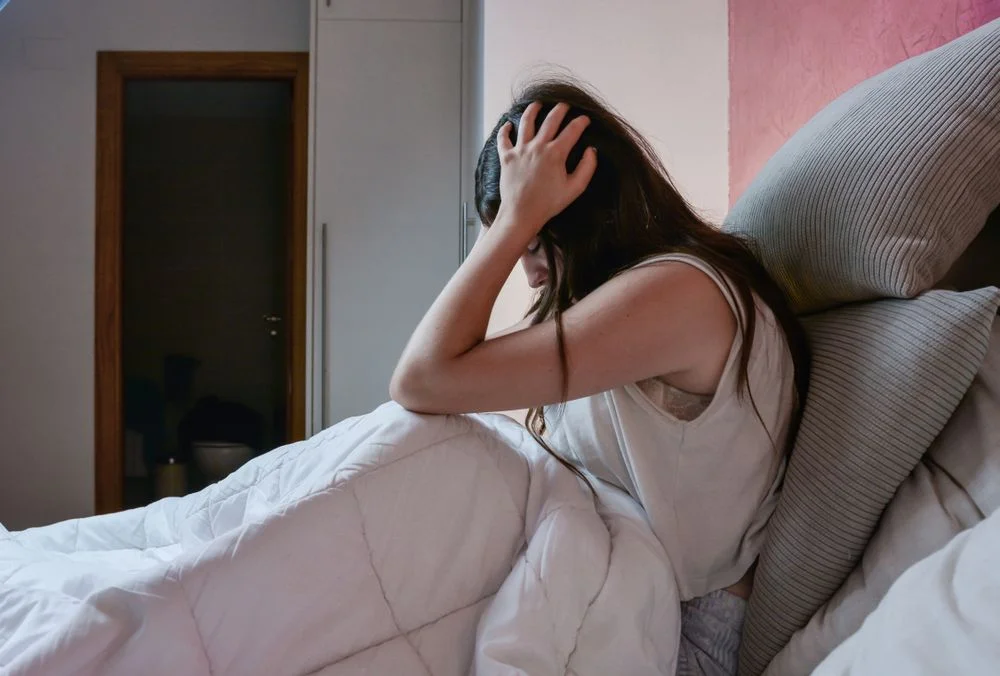
Migraines are a neurological disorder that affects over one billion people worldwide. Though many focus on the headache aspect of a migraine — which can indeed produce debilitating pain — anyone who experiences them with any regularity knows that they’re also accompanied by many, many other symptoms before, during, and after the pain phase. Symptoms such as light sensitivity (photophobia), sound sensitivity (phonophobia), sensitivity to smells (osmophobia), nausea, vomiting, loss of appetite, fatigue, and brain fog are all common during migraines, and each individual patient often has a unique pattern of symptoms. Many of these symptoms start hours or days before the pain does, in what’s called the prodrome, prodromal phase, or premonitory phase, and they can last after the pain stops in a postdrome or postdromal phase as well. Migraines can last anywhere from a few hours to a few days in total, and are a very common cause of disability.
Photograph from Luis Mario Hernandez, Noun Project.
Also of interest to many patients and providers has been the idea of triggers — things that, in isolation or combination with each other, can cause a migraine attack to start. Commonly cited triggers include bright or flashing lights, loud sounds, sleep disturbance, stress, menstruation, alcohol (particularly red wine and beer), caffeine, and foods such as chocolate or cheese. Providers and online discussions often recommend trying to avoid these triggers to reduce the frequency of migraines.
However, this can prove to be an exercise in frustration for many. Many patients make lifestyle change after lifestyle change only to see no significant reduction in their symptoms, and end up wondering why nothing seems to work for them if this is what’s supposedly causing their migraines. This has prompted researchers to look deeper into this idea of migraine triggers — and recent research is indicating that true triggers may be much less common than we’ve previously thought. Recent data is showing that many of the things commonly perceived as triggers may actually be symptoms of the migraine early in the prodromal phase. For instance, it may be that eating chocolate or drinking caffeine isn’t causing the migraine, but rather some of the earliest symptoms of the migraine are cravings for chocolate or caffeine, long before the more recognizable symptoms start. This can create the appearance of a trigger even when the order of causation is actually reversed.
What the Research Says
Research over the last handful of years has been giving increasing attention to the prodromal phase and subtle symptoms that occur during that phase, partially because in many cases, the earlier a migraine can be caught and treated, the less severe it will get. Many studies assessing migraine triggers have relied on the patients in the study to report what they perceive to be triggers, but these reports often prove inaccurate when these triggers are actually tested, especially when compared to placebo. It’s easy to misattribute migraines to things that don’t actually correlate strongly when tested — the human brain is primed for pattern-finding, especially when it’s trying to find a way to avoid pain, and sometimes perceives patterns that don’t actually hold up to close inspection as a result.
While there is limited research provocatively testing triggers (rather than relying solely on patient report) at the moment, what research has been done is producing some interesting findings. For instance, one (unfortunately relatively small) study comparing chocolate to placebo showed no significant difference between the two in likelihood to provoke a migraine, despite all subjects reporting chocolate as something they had noticed provoking migraines in the past [1]. Additionally, a systematic review of literature studying the relationship between wine intake (another common perceived trigger) and migraines found no conclusive evidence that there’s any relationship between the two [2].
Of particular interest to the discussion of whether some perceived triggers may actually be prodromal symptoms are studies comparing the two directly. One such study took a detailed history of patients with migraines regarding their perceived triggers and what symptoms they usually experience, then medically induced migraines using a nitroglycerin infusion (which has been shown to reliably induce both migraine pain and prodrome, though typically not aura in patients who usually experience migraines with aura) [3]. This study found significant correlation between perceived triggers and prodromal symptoms both in spontaneous migraines and in those induced by the nitroglycerin.
In spontaneous migraines:
- Patients who reported bright light as a trigger also reported photophobia (light sensitivity) as a prodromal symptom
- Patients who reported certain foods as a trigger also reported food cravings as a prodromal symptom
- Patients who reported hunger or skipping meals as a trigger also reported food cravings as a prodromal symptom
During induced migraines:
- Patients who reported bright light as a trigger also showed photophobia (light sensitivity) as a prodromal symptom
- Patients who reported loud sound as a trigger also showed phonophobia (sound sensitivity) as a prodromal symptom
- Patients who reported stress as a trigger also showed mood changes as a prodromal symptom
While there are slight discrepancies between these lists, these are most likely due to a combination of patients not always recognizing prodromal symptoms at home (for instance, mood change is often hard to notice unless you know to look for it or have someone else to notice it for you — it often feels like an increase in stressful circumstances, rather than reduced tolerance for stress that’s already present) and the environment being different during the induced migraine than it would be at home.
Similar results can be seen from another study, which instead of inducing migraines took a purely retrospective approach (that is, asking patients about their past migraines, rather than inducing them or recording symptoms as they happen over a period of time) in comparing perceived triggers with prodromal symptoms [4]. This study also found that patients who reported photophobia, osmophobia (sensitivity to smells), and food cravings as prodromal symptoms also reported bright or flashing lights, strong or specific smells, or certain foods as perceived migraine triggers, respectively. An additional retrospective study found similar results, correlating photophobia with bright lights as a perceived trigger, phonophobia with loud sounds as a perceived trigger, and tiredness as a prodromal symptom with sleep disturbances as a perceived trigger [5].
Takeaways for Patients
So what does this all boil down to for patients at home?
Well, the big important point is that things that seem initially like triggers may instead be early warning signs, and it’s hard to tell the difference without intentionally sitting down and recording some data. Differentiating between these two things can help narrow down what lifestyle changes will actually be helpful for you in reducing migraine symptoms, and can reduce frustration and unnecessary restrictions that aren’t helping you.
Currently, the best approach to this is keeping a journal of some kind — paper or electronic — on a daily basis. Make a daily habit of recording migraine symptoms (or lack thereof), potential prodromal symptoms (food cravings, mood disturbance, fatigue, photophobia, phonophobia, osmophobia, etc.), and your exposure to various potential triggers (stress, alcohol, meals and snacks, strenuous exercise, sleep disturbance, etc.), ideally in the evening when heading to bed. Then, after 2–3 months, you can go through the records and look for patterns of what things consistently happen on the day of or day before a migraine. This correlation can reveal what things are potential triggers for you, as well as prodromal symptoms you may not have recognized yet. (Remember when doing this to look at least 1–2 days before a migraine occurred, as both triggers and prodromal symptoms can occur as far as 48 hours in advance of when the pain starts.)
To confirm whether a suspected trigger truly is a trigger or not, it should then be tested if at all possible, either by intentionally exposing yourself to it and seeing if it consistently produces a migraine, or by cutting it out of your life for 3–4 weeks and seeing if the frequency of your migraines decreases significantly. If there was a correlation in the original data, but not when intentionally tested, you may have identified a subtle prodromal symptom. For example, if eating chocolate seems to correlate with having a migraine within 1–2 days, but when you go out of your way to test it it doesn’t consistently trigger them (and/or cutting it out of your diet entirely doesn’t seem to reduce your migraine frequency), then you might start taking note of chocolate cravings as an early warning sign of a possible migraine.
In all cases, migraine symptoms are highly individual, and there’s unfortunately no one-size-fits-all answer when it comes to which lifestyle changes are helpful for reducing migraines and which aren’t. While some attempts have been made at creating “migraine diets” and similar guidelines, these broad, sweeping sets of advice usually aren’t as effective as individualized lifestyle changes. However, taking these steps to distinguish between prodromal syndromes and migraine triggers can help you determine which lifestyle changes will be helpful for you. Moreover, identifying these subtle prodromal symptoms can also let you catch a migraine and take any rescue medication you have earlier, which can significantly improve the effectiveness of this treatment.
References
[1] Moffett, A. M., Swash, M., & Scott, D. F. (1974). Effect of chocolate in migraine: a double-blind study. Journal of neurology, neurosurgery, and psychiatry, 37(4), 445–448. https://doi.org/10.1136/jnnp.37.4.445
[2] Lucerón-Lucas-Torres, M., Ruiz-Grao, M. C., Pascual-Morena, C., Priego-Jiménez, S., López-González, M., & Álvarez-Bueno, C. (2025). Association between wine consumption and migraine: a systematic review and meta-analysis of cross-sectional. Alcohol and alcoholism, 60(2), agaf004. https://doi.org/10.1093/alcalc/agaf004
[3] Karsan, N., Bose, P., Newman, J., & Goadsby, P. J. (2021). Are some patient-perceived migraine triggers simply early manifestations of the attack?. Journal of neurology, 268(5), 1885–1893. https://doi.org/10.1007/s00415-020-10344-1
[4] Schulte, L. H., Jürgens, T. P., & May, A. (2015). Photo-, osmo- and phonophobia in the premonitory phase of migraine: mistaking symptoms for triggers?. The journal of headache and pain, 16, 14. https://doi.org/10.1186/s10194-015-0495-7
[5] Thuraiaiyah, J., Christensen, R. H., Al-Khazali, H. M., Wiggers, A., Ashina, M., & Ashina, H. (2025). Overlap between perceived triggers, premonitory symptoms and symptom persistence across migraine phases: A REFORM study. Cephalalgia, 45(8), 3331024251364234. https://doi.org/10.1177/03331024251364234
Dealing with this in West Linn, Lake Oswego or Oregon City?
Same-week appointments. PIP and most insurance accepted.