
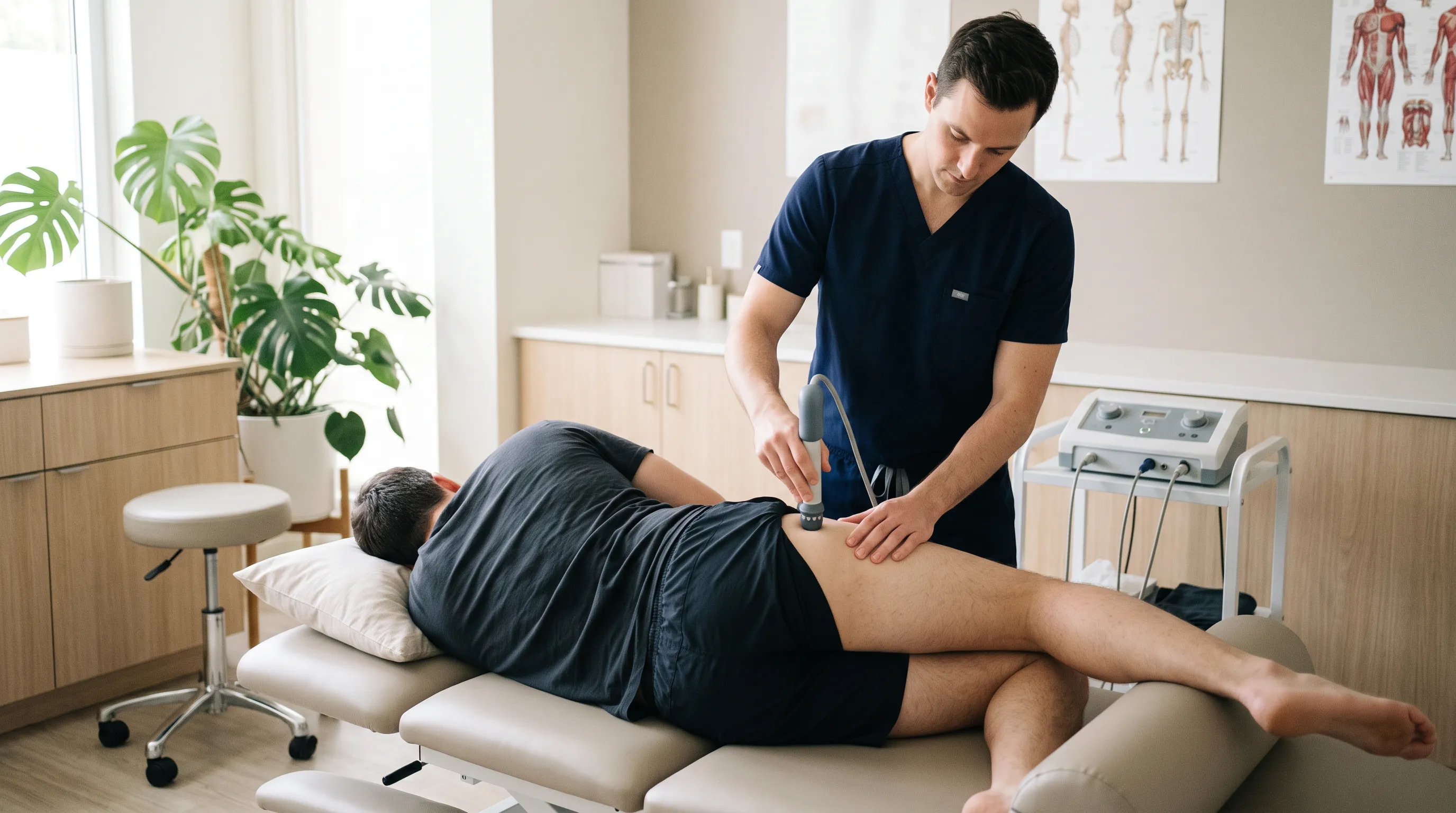
Here is something I hear from patients almost every week: they’ve been living with outer hip pain for months, sometimes years, and they assumed it was bursitis. They’ve tried cortisone injections, rest, anti-inflammatories, and maybe physical therapy. Some got better for a while, then the pain came back. A few were told surgery was their next option. When they come to us looking for shockwave therapy for hip pain near me, they are often surprised to learn that the tissue they’ve been treating may not be the whole story, and that a non-invasive acoustic wave treatment may be exactly what that stubborn tissue has been missing.
The Hip Pain Diagnosis Problem: Bursitis or Tendinopathy?
For decades, outer hip pain was almost universally labeled “greater trochanteric bursitis,” implying the bursa, a fluid-filled sac near the hip bone’s bony prominence, was inflamed and needed to be calmed down. More recent imaging research has complicated that picture significantly.
A landmark 2016 systematic review in the British Journal of Sports Medicine found that true bursal inflammation is relatively rare in isolation. In most cases, the dominant pathology is tendinopathy of the gluteal tendons, specifically the gluteus medius and gluteus minimus, where they attach to the greater trochanter. The bursa may be irritated secondarily, but treating only the bursa misses the underlying tendon degeneration.
This matters because bursitis and tendinopathy respond differently to treatment. Cortisone injections can quiet bursal inflammation, but they have a poor long-term track record for tendinopathy and can actually weaken tendon tissue with repeated use. Rest allows the painful irritation to settle but does nothing to repair the disorganized collagen in a degenerative tendon. That is where SoftWave therapy for hip pain enters the picture.
What SoftWave Actually Does Inside the Hip
SoftWave TRT (Tissue Regeneration Technology) delivers low-to-medium energy acoustic pressure waves into soft tissue using a handheld device that is applied to the outer hip. The waves are unfocused, covering a broader treatment zone than traditional focused shockwave units, which makes them well suited to the spread-out anatomy of the gluteal tendons along the greater trochanter.
The biological response to these waves is specific and well documented:
Mechanotransduction is the first step. The acoustic force is detected by cells in the tendon and surrounding tissue, which triggers a cascade of cellular repair responses. Put simply: the cells respond to mechanical stress by activating their repair pathways, the same way bone cells respond to weight-bearing.
VEGF upregulation and neovascularization follow. Vascular endothelial growth factor (VEGF) is a signaling protein that stimulates the growth of new blood vessels. Degenerative tendons are classically hypovascular, meaning they have poor blood supply and therefore poor healing capacity. The acoustic waves stimulate VEGF expression, which prompts new capillary formation. New blood supply means nutrients, growth factors, and immune cells can actually reach the damaged tissue.
Collagen synthesis stimulation restores structural integrity. Fibroblasts in the tendon are activated to produce new collagen. Over six to twelve weeks, this translates to a measurable improvement in tendon organization and tensile strength.
Anti-inflammatory cytokine modulation reduces chronic pain signals. SoftWave does not blunt inflammation the way a steroid does. It shifts the tissue environment from a chronic inflammatory state toward an active healing state, which reduces pain more durably.
What the Research Shows for Hip Tendinopathy
The evidence base for extracorporeal shockwave therapy (ESWT) in greater trochanteric pain syndrome is now one of the stronger cases in musculoskeletal medicine.
A 2024 randomized controlled trial published in the Journal of Orthopaedic and Sports Physical Therapy compared shockwave therapy plus an exercise program to exercise alone in 94 patients with chronic gluteal tendinopathy. At 24-week follow-up, the shockwave group showed significantly greater reductions in pain scores and greater improvements in hip function. The researchers noted that shockwave appeared to accelerate the tissue remodeling that exercise alone stimulates more slowly.
A 2023 systematic review in Physical Therapy in Sport pooled data from eight trials and concluded that ESWT produced clinically meaningful improvements in pain and function in greater trochanteric pain syndrome, with effect sizes comparable to corticosteroid injection at short-term follow-up and superior outcomes at six and twelve months.
A 2025 retrospective cohort study from an orthopedic center in Amsterdam looked at patients who had failed two or more cortisone injections and found that a series of SoftWave treatments produced meaningful pain reduction in 73 percent of that refractory group. That is a population that many clinicians consider very difficult to treat.
I find this last study particularly relevant because I see this patient profile often in West Linn, Oregon: people who have already been through the standard treatment sequence and are looking for something that actually addresses the tissue, not just the symptoms.
Shockwave Therapy for Hip Pain Near Me: What Treatment Looks Like
A typical SoftWave protocol for hip tendinopathy at our West Linn clinic involves three to six sessions over three to six weeks, depending on the severity and chronicity of the condition. Each session takes about fifteen to twenty minutes. We apply the handheld device directly to the outer hip, working along the attachment zone of the gluteal tendons.
Most patients feel some mild discomfort during treatment, usually described as a deep pressure or buzzing sensation. It is not painless, but it is well tolerated and there is no downtime afterward. Many patients notice a reduction in their baseline pain within two to three sessions, though the full structural benefit develops over several weeks as the collagen remodeling completes.
We typically combine SoftWave with a home exercise program focused on gluteal tendon loading because the research consistently shows that combining shockwave with tendon-specific exercise produces better outcomes than either approach alone.
What SoftWave Will Not Do, and Who It Is Not Right For
I want to be direct about this because I think patients deserve honesty.
SoftWave will not regenerate a completely torn gluteal tendon. If you have a full-thickness tear confirmed on MRI, that is a surgical conversation, and I will tell you so clearly rather than put you through a treatment course that cannot help.
It is also not a one-session cure. Tissue remodeling takes time. Patients who expect to feel dramatically better after the first treatment are sometimes disappointed; the cumulative response over a full protocol is where the meaningful change happens.
Contraindications include active infection over the treatment area, blood clotting disorders or anticoagulant therapy, local malignancy, and pregnancy. We review all of these at the initial consultation.
For patients with significant structural hip pathology, labral tears, osteoarthritis, or femoroacetabular impingement, SoftWave may be part of a larger care plan but is unlikely to be the complete answer on its own. Getting the diagnosis right matters before choosing the treatment.
If This Sounds Like Your Hip
If you have been dealing with outer hip pain, particularly pain with lying on that side, climbing stairs, or sitting for long periods, and you have not found lasting relief with injections or rest, I think it is worth having a conversation about whether SoftWave is appropriate for you.
If you have questions or want to find out whether SoftWave therapy is a good fit for your care plan, we’re easy to reach. That’s what we’re here for.
Dr. Tristan Santiago Maceiras is a Doctor of Chiropractic at Gentle Care Chiropractic in West Linn, Oregon, specializing in musculoskeletal medicine, SoftWave therapy, and integrated care.
Frequently Asked Questions
How many SoftWave treatments does hip tendinopathy typically require?
Most patients with greater trochanteric pain syndrome complete three to six sessions over three to six weeks. Chronic or more severe cases may benefit from a slightly longer protocol. We reassess after the initial series to determine whether additional treatment is warranted.
Is SoftWave the same as cortisone for hip bursitis?
No. Cortisone reduces inflammation quickly but has limited long-term effectiveness for tendinopathy and can weaken tendon tissue with repeated use. SoftWave works differently: it stimulates the tissue’s own repair mechanisms, promoting new blood vessel growth, collagen synthesis, and anti-inflammatory signaling. The effects develop more gradually but tend to be more durable.
Can shockwave therapy for hip pain near me help if I’ve already had two cortisone injections that didn’t last?
Yes, in many cases. A 2025 cohort study found that SoftWave produced meaningful pain reduction in 73 percent of patients who had already failed two or more cortisone injections. This is precisely the patient population where SoftWave tends to offer something that prior treatments could not: actual tissue repair rather than symptom suppression.
Is greater trochanteric bursitis the same as gluteal tendinopathy?
Not exactly. For years, outer hip pain was attributed almost entirely to inflammation of the bursa. More recent research shows that most cases involve degeneration of the gluteus medius or minimus tendon at its attachment point on the greater trochanter. The bursa may be irritated secondarily. This distinction matters for treatment because tendinopathy requires a different approach than pure bursal inflammation.
Is SoftWave therapy covered by insurance for hip pain?
Most insurance plans in the United States do not currently cover SoftWave or extracorporeal shockwave therapy for soft tissue conditions. We discuss pricing and payment options transparently during the consultation at our West Linn clinic so there are no surprises.
Dealing with this in West Linn, Lake Oswego or Oregon City?
Same-week appointments. PIP and most insurance accepted.