
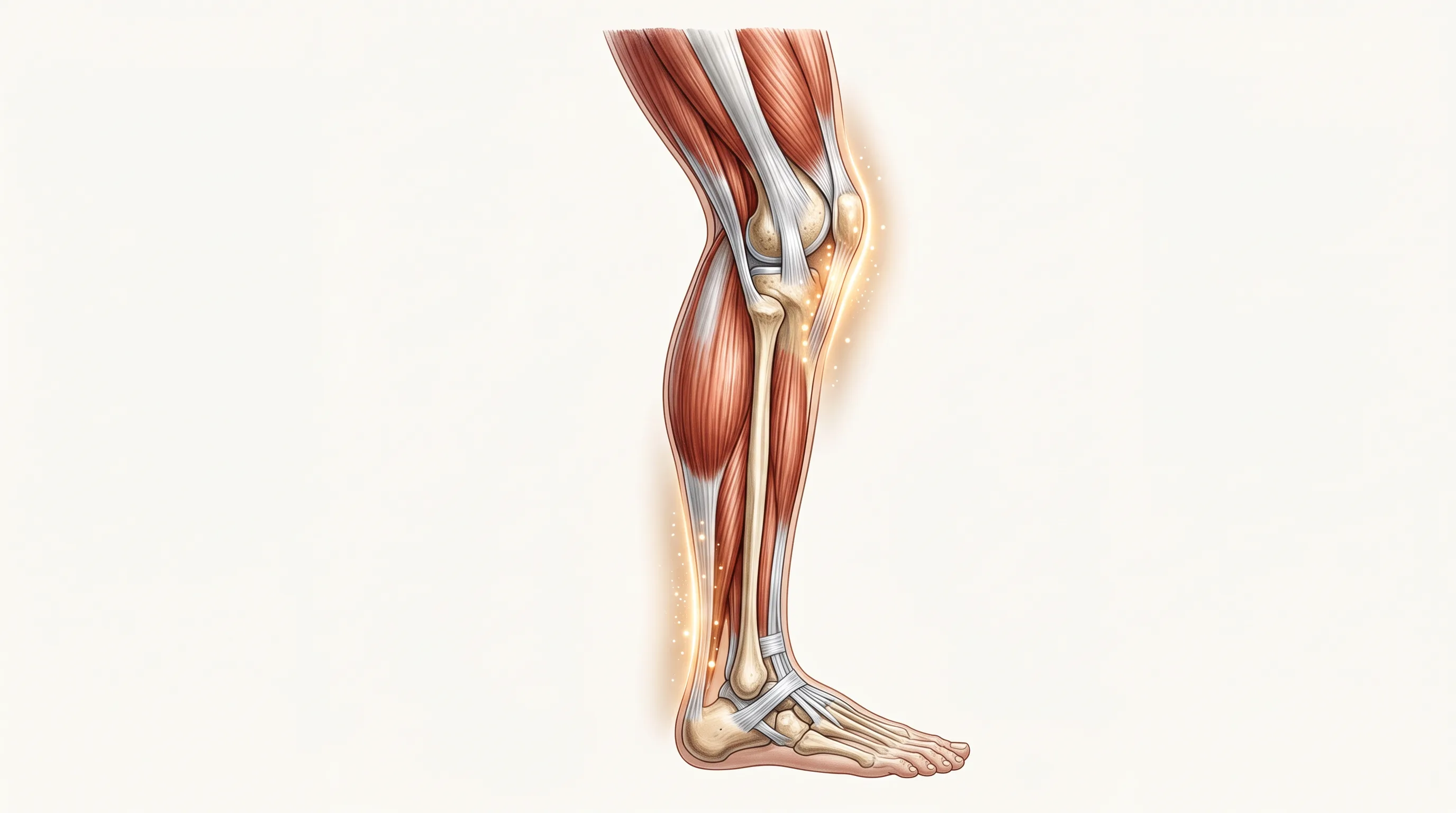
Most patients I see with chronic tendon pain have already done the right things. They rested it, iced it, took ibuprofen, and some completed a full course of physical therapy with eccentric loading protocols. And yet, months later, the pain persists, particularly with those first steps out of bed or the moment they try to return to the activities they love.
What they’re dealing with isn’t a simple injury that time will fix. It’s tendinopathy: a degenerative process inside the tendon where normal tissue has broken down and failed to repair itself. Shockwave therapy for tendinopathy works precisely because it intervenes in that biology directly, at the level of the cells that are supposed to heal the tendon but have stalled out.
Here’s what I tell patients: the tendon isn’t inflamed the way a fresh sprain is. In chronic tendinopathy, the tissue has gone into a metabolic standstill. The body’s repair machinery has been running ineffectively for so long that the tendon is now structurally disorganized, with abnormal collagen cross-linking, poor vascularity, and an absence of the signals needed to restart healing. SoftWave therapy, a form of extracorporeal shockwave therapy (ESWT), restores those signals.
How Shockwave Therapy Wakes Up a Failing Tendon
SoftWave technology delivers acoustic pressure waves into tissue in a wide, unfocused pattern that stimulates a broad region of the tendon and surrounding structures. The mechanism isn’t blunt trauma. It’s mechanotransduction: the conversion of mechanical force into biochemical signals that cells recognize and respond to.
Here’s what happens at the cellular level, and what each step means for a patient:
Collagen synthesis stimulation. Tenocytes (the cells that produce and maintain tendon tissue) are activated by the mechanical signal from shockwaves. They begin producing new Type I collagen, the structural collagen that makes tendons strong and load-tolerant. In degenerated tendons, this process has stalled. Shockwave therapy restarts it.
VEGF upregulation and neovascularization. Vascular endothelial growth factor (VEGF) promotes the growth of new blood vessels. Chronic tendons have poor blood supply, which is why they heal so slowly. When SoftWave stimulates VEGF production, new capillaries grow into the tendon, restoring the oxygen and nutrient delivery that repair requires. These improved healing conditions persist long after the treatment sessions.
Anti-inflammatory cytokine modulation. Shockwave therapy reduces substance P (a neuropeptide involved in pain transmission) and shifts the tissue environment away from the chronic low-grade inflammatory state that characterizes tendinopathy. Patients often notice reduced baseline aching and morning stiffness within the first few weeks.
What Studies Show About Shockwave Therapy for Tendinopathy
The evidence base for shockwave therapy in tendinopathy is among the strongest in musculoskeletal medicine, particularly for three locations: the rotator cuff, the Achilles tendon, and the patellar tendon.
For rotator cuff tendinopathy, a 2025 systematic review published in the Journal of Shoulder and Elbow Surgery analyzed 18 randomized controlled trials and found that ESWT produced clinically significant reductions in pain and improvements in shoulder function, with effects maintained at 12-month follow-up. Outcomes were superior to placebo and comparable to corticosteroid injection at six months, but without the tissue-weakening side effects associated with repeated steroid injections.
For Achilles tendinopathy, a 2024 RCT published in the British Journal of Sports Medicine compared ESWT combined with eccentric exercise to eccentric exercise alone in 96 patients with chronic mid-portion Achilles pain. At 16 weeks, the combination group showed significantly greater reductions in pain and improved return-to-activity scores. The authors noted that shockwave therapy appeared to accelerate the structural remodeling that eccentric loading initiates, an important finding for athletes trying to return to training.
For patellar tendinopathy (commonly called jumper’s knee), a 2024 study in the American Journal of Sports Medicine followed 68 recreational and competitive athletes through a 12-week ESWT protocol. Sixty-three percent reported greater than 50% pain reduction, and ultrasound imaging confirmed structural improvement in tendon quality. This imaging verification is important: it tells us the treatment isn’t just masking pain but producing actual tissue change.
The Three Tendinopathies We Treat Most at Our West Linn, Oregon Clinic
In practice, I use SoftWave therapy most frequently for three clinical presentations:
Rotator cuff tendinopathy. Patients typically describe a dull ache in the outer shoulder that worsens with overhead activity, reaching behind the back, or sleeping on that side. This usually reflects supraspinatus or infraspinatus involvement, sometimes accompanied by calcific deposits. SoftWave treats the underlying tendon degeneration directly and pairs well with targeted rehabilitation to restore shoulder mechanics.
Mid-portion and insertional Achilles tendinopathy. Morning stiffness, pain after prolonged sitting, and discomfort that initially improves with walking but worsens with longer or faster activity are the hallmarks. Insertional cases (where the tendon meets the heel bone) can be more resistant to treatment, but SoftWave has demonstrated good results at both sites, and the combination with loading exercise significantly improves outcomes.
Patellar tendinopathy. Pain at the base of the kneecap, particularly with squatting, descending stairs, or landing from a jump. This is common in runners, basketball players, volleyball players, and anyone whose lower-body training volume has increased faster than their tendons could adapt.
What SoftWave Therapy Won’t Do, and Who Should Avoid It
I want to be straightforward about this.
SoftWave therapy does not produce overnight results. The biological processes it initiates take weeks to complete. Most patients need 3 to 6 sessions, and meaningful improvement typically builds over 4 to 12 weeks following treatment. Some patients feel modest immediate relief; others feel slightly more sore before they improve, which reflects normal tissue response to acoustic stimulation.
SoftWave is not appropriate for everyone. Contraindications include active infection in the treatment area, malignancy at or near the site, pregnancy, implanted cardiac devices near the treatment field, and clotting disorders or active anticoagulant therapy. A thorough intake evaluation identifies these before treatment begins.
It will not replace rehabilitation. Tendon healing requires progressive mechanical loading to organize new collagen properly. SoftWave creates the biological conditions for repair; appropriate rehab exercise directs that repair. I treat SoftWave as one component of a complete care plan, not a standalone solution.
Finally, a full-thickness tendon rupture is not a tendinopathy. If imaging shows a structural tear rather than degeneration, SoftWave is not the right intervention. That distinction requires proper diagnosis, including clinical examination and often ultrasound or MRI.
Frequently Asked Questions: Shockwave Therapy for Tendinopathy
How many SoftWave sessions do I need for tendinopathy? Most protocols call for 3 to 6 sessions, spaced 5 to 10 days apart. Chronic cases or those with notable structural changes on imaging sometimes benefit from an extended course. We assess response after each session and adjust the plan accordingly.
Does shockwave therapy hurt? SoftWave therapy uses unfocused acoustic waves and is generally well tolerated. Most patients feel moderate pressure and some temporary discomfort in sensitive areas, but it’s rarely described as painful. There is no injection, no incision, and no recovery period.
Can I keep exercising while receiving rotator cuff shockwave therapy? Yes. We typically ask patients to avoid high-load activity (overhead pressing, heavy lifting, sprinting) for 24 to 48 hours after each session, but gentle movement and walking are encouraged. Specific loading exercises are often integrated into the protocol from early on and are a core part of how treatment works.
How does shockwave therapy for tendinopathy compare to a cortisone injection? Corticosteroid injections can provide faster short-term pain relief, but research consistently shows that benefit erodes by 3 to 6 months. Repeated injections weaken tendon tissue over time. Shockwave therapy takes longer to build its effects but produces more durable structural improvement without those risks. For most patients with chronic tendinopathy rather than acute bursitis or synovitis, shockwave therapy is now the preferred first-line intervention in my practice.
Is SoftWave therapy for tendinopathy covered by insurance? Coverage varies by plan and carrier. Some policies cover ESWT for specific diagnoses; coverage for tendinopathy at sites other than the plantar fascia is less consistent. We can help patients understand their benefits and, when needed, discuss available options.
If you have questions or want to find out whether SoftWave therapy is a good fit for your care plan, we’re easy to reach. That’s what we’re here for.
Dr. Tristan Santiago Maceiras is a Doctor of Chiropractic at Gentle Care Chiropractic in West Linn, Oregon, specializing in musculoskeletal medicine, SoftWave therapy, and integrated care.
Dealing with this in West Linn, Lake Oswego or Oregon City?
Same-week appointments. PIP and most insurance accepted.