
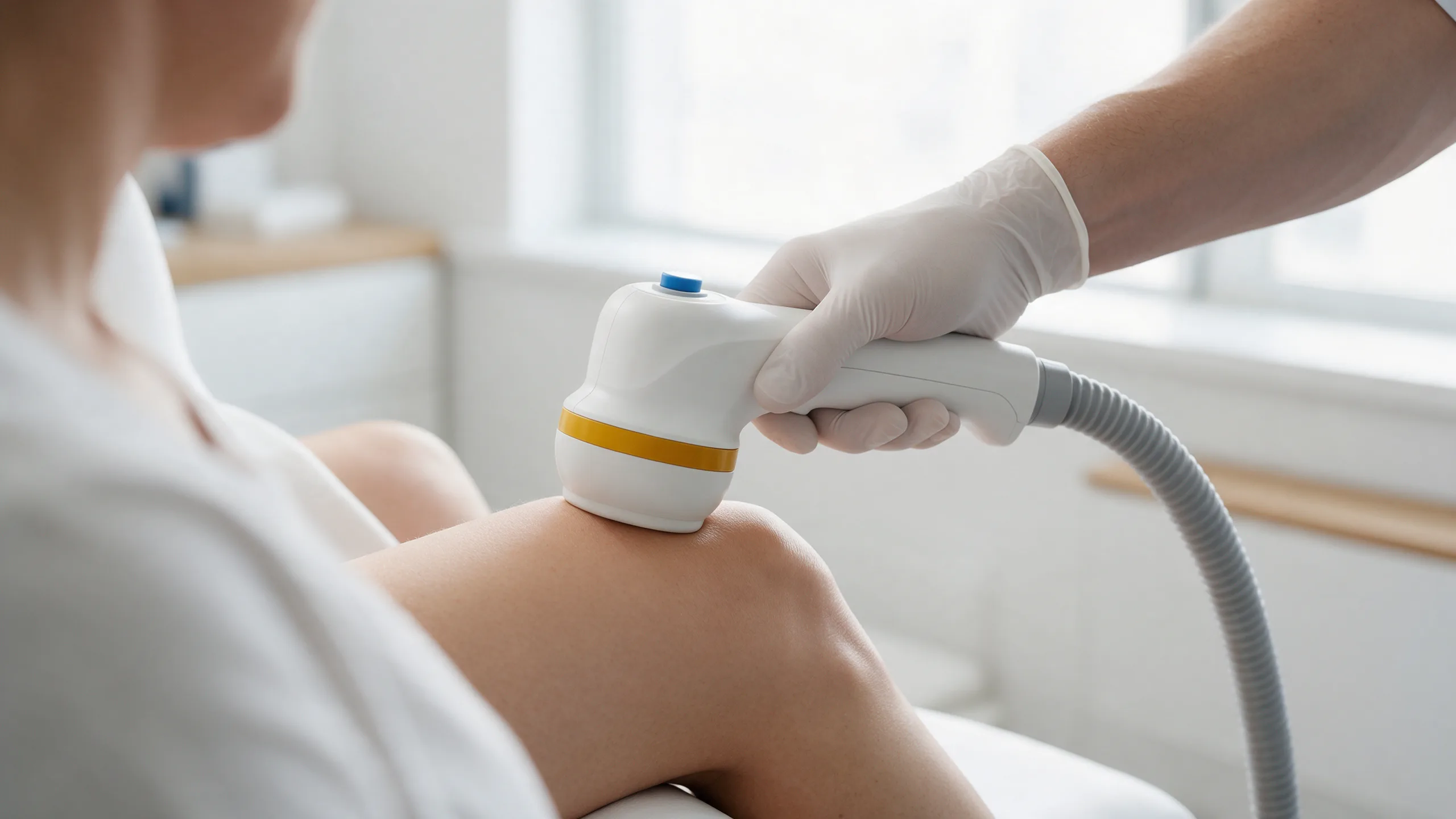
Most treatments work by doing something to tissue. SoftWave therapy works by convincing tissue to do something itself.
That distinction matters. When patients search for “shockwave therapy near me,” they often expect something aggressive, something that breaks things up or forces a result. What they get with SoftWave TRT (tissue regeneration therapy) is a targeted acoustic stimulus that engages the biology of tissue repair at the cellular level. The device doesn’t heal you. It creates the conditions under which your body heals itself. For chronic musculoskeletal conditions where that process has stalled, that difference is the whole point.
Here is what is actually happening when we use SoftWave therapy at our clinic in West Linn.
What SoftWave Therapy Is, and What Separates It from Other Shockwave Devices
SoftWave TRT uses broad-focused, unfocused electrohydraulic acoustic waves. These are not ultrasound waves. They are not focused piezoelectric or radial ballistic shockwaves. The distinction is clinically meaningful: unfocused electrohydraulic technology covers a wider surface area at lower pressure per unit than focused devices, which changes both the patient experience and the mechanism of action.
The device generates acoustic pulses transmitted through a water-filled applicator into tissue. At the cellular level, those pulses produce mechanotransduction: the conversion of a physical stimulus into biochemical signals. This is the same process your bones use to remodel under load, and the same one your tendons use to adapt to exercise. SoftWave therapy applies that biological language therapeutically.
The Cellular Mechanisms Behind SoftWave Tissue Regeneration
Stem cell recruitment via TLR3 and SDF-1. Acoustic stimulation activates toll-like receptor 3 (TLR3), a pattern recognition receptor that triggers the release of stromal cell-derived factor-1 (SDF-1). SDF-1 functions as a homing signal for mesenchymal stem cells circulating in the bloodstream. A 2023 study in Stem Cell Research and Therapy confirmed elevated SDF-1 expression and increased stem cell migration at SoftWave-treated sites in a tendon model. In patient terms: your body’s own repair cells are recruited to exactly where they are needed.
Nitric oxide and new blood vessel formation. Electrohydraulic shockwave upregulates endothelial nitric oxide synthase (eNOS), increasing local nitric oxide (NO) production. Nitric oxide dilates blood vessels, reduces local inflammation, and promotes angiogenesis. Tendons and fascial tissues are notoriously hypovascular at their insertion points, which is one reason chronic tendinopathy doesn’t resolve on its own. Improving the vascular environment is often what finally shifts the tissue out of chronic degeneration.
VEGF expression. Vascular endothelial growth factor (VEGF) rises significantly following electrohydraulic shockwave application, driving new capillary formation in areas that were functionally avascular. This is a structural change, not just a pain-signaling change.
Substance P reduction. Substance P is a neuropeptide central to pain transmission and neurogenic inflammation. A 2024 systematic review in Pain Medicine documented significant reductions in substance P following repeated shockwave applications. Less substance P means less central sensitization, which helps explain why patients often notice improvement in pain well before visible tissue changes would be detectable on imaging.
Together, these mechanisms move tissue from a chronic inflammatory holding pattern toward active regeneration. The biology does the work. SoftWave provides the signal.
Which Conditions Respond to SoftWave Therapy
The evidence base for SoftWave therapy and electrohydraulic shockwave is strongest for chronic musculoskeletal conditions that haven’t responded to standard conservative care.
Plantar fasciitis. Evidence here is robust. A 2025 RCT in the Journal of Orthopaedic Research found statistically significant improvement in both pain scores and functional outcomes at 12 weeks for electrohydraulic shockwave versus sham. Response rates in well-selected chronic plantar fasciitis patients consistently run 70 to 85 percent in published trials.
Lateral epicondylitis (tennis elbow). A 2023 Cochrane review update confirmed shockwave therapy as a first-line recommendation for chronic lateral epicondylitis not responding to conservative care, with long-term outcomes superior to corticosteroid injection.
Calcific rotator cuff tendinopathy. Shockwave is one of the only non-surgical interventions with direct evidence for calcium resorption. A 2024 meta-analysis in JSES International confirmed superiority over sham for deposits under 15mm, with outcomes comparable to ultrasound-guided needling.
Myofascial pain and chronic low back pain. Evidence here is positive but more heterogeneous. I use SoftWave for myofascial presentations selectively, as one component within a broader care plan, not as a standalone solution.
At Gentle Care Chiropractic, SoftWave therapy is almost never the only treatment in a patient’s plan. We use it alongside chiropractic adjustments, Class IV laser therapy, or rehabilitation exercise, depending on the presentation and what the tissue actually needs.
What SoftWave Therapy Will Not Do: Scope and Contraindications
This is the section I spend the most time on with patients, because it’s where decisions about care go right or wrong.
SoftWave therapy is not a structural fix. If a disc herniation is compressing a nerve root, or a joint has lost significant cartilage, SoftWave can reduce surrounding inflammation and improve the tissue environment, but it will not relocate a disc or regenerate hyaline cartilage. Those are different problems that require different solutions.
The research base is built on chronic conditions. “Chronic” in this context typically means pain lasting more than three months with incomplete response to other conservative care. Using shockwave in the acute phase, the first few weeks after an injury, is not well-supported and may interfere with the normal inflammatory healing response.
Results are not immediate. The biology of tissue regeneration takes time. Most patients notice meaningful improvement between sessions three and five of a standard six-session course. Patients who stop after one or two sessions because they don’t feel a dramatic change are discontinuing something that was likely working.
Absolute contraindications include active malignancy at or near the treatment area, pregnancy, coagulopathy or anticoagulant therapy, active infection, and open wounds. Patients with cardiac pacemakers require explicit cardiology clearance before treatment. These aren’t fine-print warnings. They reflect real biological risks.
Frequently Asked Questions
Is SoftWave therapy the same thing as shockwave therapy?
SoftWave TRT is a specific type of shockwave therapy using an unfocused electrohydraulic applicator. Most devices marketed as “shockwave” use either radial (ballistic) or focused piezoelectric technology. The waveform characteristics differ in clinically significant ways: unfocused electrohydraulic waves penetrate more deeply and cover a wider area, which is why they’re well-suited for plantar fasciitis, myofascial trigger points, and large tendon insertions rather than small focal calcifications. When searching for “shockwave therapy near me,” it’s worth asking specifically which device type a clinic uses.
How many SoftWave therapy sessions will I need?
The standard protocol for most musculoskeletal conditions is six sessions, typically spaced one week apart. Some patients with chronic or complex presentations extend to eight to ten sessions. I guide that decision based on symptom trajectory and functional improvement rather than a fixed number. If there is no meaningful change after five sessions, we reassess the diagnosis before continuing.
Is SoftWave TRT covered by insurance?
Coverage is inconsistent. Most commercial health insurers still classify SoftWave TRT as investigational for musculoskeletal indications, though billing codes exist for shockwave therapy. We offer transparent cash-pay pricing and verify your benefit plan before your first visit. For patients with Oregon PIP auto insurance, coverage varies by payer and we check eligibility directly.
Does SoftWave therapy hurt?
Most patients describe a mild tapping or pressure sensation. At therapeutic intensity, there can be localized discomfort, particularly over inflamed or sensitive tissue. I adjust parameters based on tolerance, especially in the first session or two. Mild soreness for 24 to 48 hours after treatment is normal and reflects the biological response, not damage to tissue.
How is SoftWave therapy different from Class IV laser or red light therapy?
All three are non-invasive energy-based therapies, but their mechanisms are distinct. Class IV laser and red light therapy work through photochemical pathways: photons are absorbed by cytochrome c oxidase in mitochondria, increasing cellular energy production and reducing oxidative stress. SoftWave works through mechanotransduction: acoustic pressure waves, not light. In some presentations we use them together, because they act on different aspects of the same tissue problem.
If you have questions or want to find out whether SoftWave therapy is a good fit for your care plan, we’re easy to reach. That’s what we’re here for.
Dr. Tristan Santiago Maceiras is a Doctor of Chiropractic at Gentle Care Chiropractic in West Linn, Oregon, specializing in musculoskeletal medicine, MVA recovery, and integrated care.
Dealing with this in West Linn, Lake Oswego or Oregon City?
Same-week appointments. PIP and most insurance accepted.