
Most patients who arrive at my office with a herniated disc have already been given one of two answers: take ibuprofen and wait, or schedule a surgical consultation. Neither feels satisfying. The first dismisses real, often disabling pain. The second feels extreme for a problem that, in a significant majority of cases, can be addressed without an operating room. There is a third path that sits between watchful waiting and surgery, one with a growing body of controlled research behind it: spinal decompression therapy.
If you have searched for “spinal decompression near me” and found yourself uncertain about what the treatment actually involves, this is a straightforward explanation.
What a Herniated Disc Actually Is (and Why It Hurts)
Your lumbar discs function as hydraulic shock absorbers between each vertebra. Each disc has two structural layers: a tough outer ring called the annulus fibrosus and a soft, pressurized center called the nucleus pulposus. When repetitive loading, trauma, or age-related dehydration creates fissures in the annulus, the nucleus material can press outward. That outward displacement is a herniation.
The resulting pain has both a mechanical and a chemical component. Mechanically, herniated material can compress a nerve root directly, producing the classic pattern of sciatic pain radiating down one leg. Chemically, the nucleus pulposus contains phospholipase A2 (PLA2), an enzyme that is directly irritating to neural tissue. Even without significant structural compression, PLA2 contact with a nerve root triggers a significant inflammatory and pain response. Treating the pain effectively means addressing both components, not just one.
What Spinal Decompression Actually Does to Your Disc
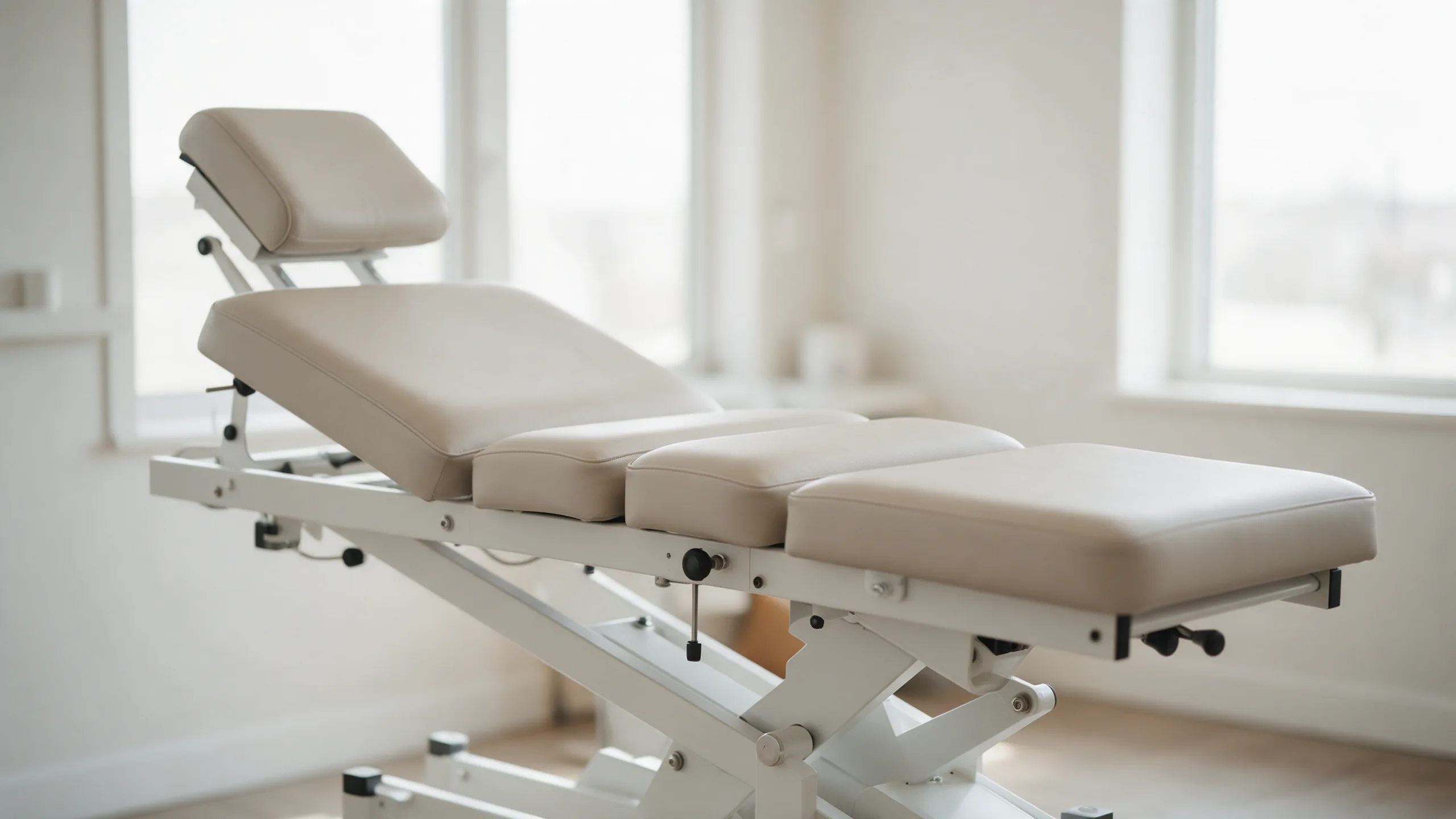
Motorized spinal decompression uses a computer-controlled traction table to apply carefully calibrated, cyclic tension to the lumbar spine. The force is customized to your body weight and the specific level of disc involvement. Sessions alternate between tension and partial release across a 30- to 45-minute treatment period.
That cycling is not incidental. Research has consistently shown that sustained traction increases intradiscal pressure; cyclic traction does the opposite. During the tension phase, controlled studies have measured negative intradiscal pressure of minus 150 to minus 160 mmHg inside the disc. That negative pressure produces two clinically meaningful effects.
First, it creates a retraction force on displaced nuclear material, pulling it back toward the center of the disc. This is not universal across all herniation types, and I will address that below, but it is a documented, reproducible phenomenon in appropriate candidates.
Second, and important for long-term recovery, the cyclic pressure gradient restores nutrient imbibition to the disc. Intervertebral discs have no direct blood supply after early childhood. They obtain oxygen, glucose, and metabolic substrates through fluid exchange driven by pressure differences. Disc degeneration is fundamentally a problem of disc dehydration and cellular malnutrition. Cyclic decompression reestablishes the pressure gradients that allow the disc matrix to take up nutrients and support tissue repair.
What the Evidence Actually Shows
A 2021 systematic review in the Journal of Physical Therapy Science analyzed outcomes across multiple controlled trials of motorized lumbar decompression and found statistically significant reductions in both pain intensity and disability scores in patients with lumbar disc herniation.
A 2019 randomized controlled trial published in the Annals of Rehabilitation Medicine compared motorized decompression directly against conventional physical therapy in patients with lumbar radiculopathy. The decompression group showed superior functional outcomes at 12-week follow-up.
These are not isolated results. Multiple controlled trials confirm that spinal decompression is effective for appropriate candidates with herniated discs, particularly for those with nerve root involvement (radiculopathy) producing leg pain, numbness, or weakness. The evidence is strongest for L4-L5 and L5-S1 herniations, which are also the most commonly presenting levels.
The magnitude of benefit varies by patient and by disc condition. I am not describing a passive cure that produces identical results in every case. But for the right candidate, non-surgical spinal decompression is one of the most evidence-supported tools we have for herniated disc pain.
What Spinal Decompression Will Not Do (And Who Should Not Receive It)
Most websites promoting decompression skip this part. I think it is the most important part.
Spinal decompression will not reverse severe disc degeneration or restore a collapsed disc that has lost substantial height and hydration. It will not fix structural instability in the spine. In some cases with sequestered disc fragments (free nuclear material that has broken off), the retraction effect is limited or not applicable.
Spinal decompression is not appropriate for patients with:
- Vertebral fractures or moderate to severe osteoporosis
- Spinal fusion hardware at the treatment level (decompressive forces can stress adjacent segments)
- Active spinal infection, tumor, or metastatic disease
- Progressive neurological deficit (worsening weakness or loss of bowel or bladder function; these require urgent surgical evaluation)
- Moderate to severe spinal canal stenosis with significant neurological compromise that has not responded to conservative care
- Pregnancy
- Abdominal aortic aneurysm or severe vascular disease
At Gentle Care Chiropractic in West Linn, Oregon, we evaluate every patient carefully before initiating decompression. That includes reviewing available imaging (MRI is the most useful), a detailed orthopedic and neurological examination, and an honest conversation about what decompression can and cannot reasonably achieve in your specific situation. If I do not think it is the right approach for you, I will say so and we will discuss what is.
What Treatment Looks Like at Our West Linn Clinic
A standard decompression course at our clinic runs 15 to 24 sessions over four to six weeks, typically three to five days per week. Sessions are 30 to 45 minutes and are not painful. Most patients describe a gentle, rhythmic pulling sensation and find the treatment relaxing.
We routinely combine decompression with adjunct therapies because disc healing responds well to a multi-modal approach. Class IV laser therapy applied to the treatment region supports cellular repair by stimulating mitochondrial activity through photobiomodulation, which complements the nutrient imbibition that decompression promotes. Electrical stimulation can reduce concurrent paraspinal muscle guarding. Therapeutic exercise is introduced progressively to support stability as pain decreases.
We track outcomes at regular intervals and adjust the protocol accordingly. Some patients notice meaningful reduction in pain and leg symptoms within the first two to three weeks. Others require the full course. We work with what the data shows, not a fixed expectation.
If You Have Been Told Surgery Is Your Only Option
A surgeon who tells you surgery is the only option is working from their own discipline’s toolbox. That is not a criticism; surgical intervention is genuinely appropriate for some patients, particularly those with progressive neurological deficits or herniations that have not responded to an adequate course of conservative care.
But the evidence is clear that most lumbar disc herniations improve significantly with conservative management over time, and that surgical and non-surgical outcomes converge in many populations at the 12- to 24-month mark. Non-surgical spinal decompression is a meaningful step worth exploring before a surgical decision is made.
If you have questions or want to find out whether spinal decompression is a good fit for your care plan, we’re easy to reach. That’s what we’re here for.
Frequently Asked Questions
Is spinal decompression the same as traction?
They share a principle but differ meaningfully in execution. Traditional traction applies a sustained, fixed pulling force. Motorized spinal decompression uses computer-controlled cyclic tension and release, which generates negative intradiscal pressure more effectively than sustained traction. The specificity of force angle, magnitude, and treatment duration is also far greater with decompression devices.
How many sessions does spinal decompression require?
Most protocols involve 15 to 24 sessions over four to six weeks, three to five times per week. The benefit is cumulative: earlier sessions begin reducing inflammation and nerve irritation, while later sessions support deeper disc tissue repair. Completing the full course matters for lasting results.
Does spinal decompression work for sciatica?
Yes, when the sciatica is caused by lumbar disc herniation compressing a nerve root, spinal decompression is one of the most appropriate and evidence-supported non-surgical treatments available. The evidence is strongest for L4-L5 and L5-S1 levels with associated radiculopathy. When sciatica originates from other sources (such as piriformis syndrome or spinal stenosis), the indication changes and the evaluation changes with it.
Will my insurance cover spinal decompression therapy near me?
Coverage varies by payer. Many commercial insurance plans classify motorized decompression as investigational or experimental, while others cover it under specific diagnostic codes. PIP (personal injury protection) auto insurance often does cover spinal decompression following a motor vehicle accident. We review your coverage during the initial consultation and discuss all payment options, including cash-pay and financing arrangements.
Can spinal decompression make a disc herniation worse?
In appropriately selected patients, there is no evidence that motorized spinal decompression worsens disc herniations. The contraindication screening process is what makes decompression safe: we do not begin treatment without a clinical examination and review of relevant imaging. That evaluation is the safeguard, and it is not optional at our clinic.
Dr. Tristan Santiago Maceiras is a Doctor of Chiropractic at Gentle Care Chiropractic in West Linn, Oregon, specializing in musculoskeletal medicine, MVA recovery, and integrated care.
Dealing with this in West Linn, Lake Oswego or Oregon City?
Same-week appointments. PIP and most insurance accepted.