

Lumbar Disc Injury/Herniation from MVA
Expert care for Lumbar Disc Injury/Herniation from MVA at Gentle Care Chiropractic in West Linn, Oregon.
Understanding Lumbar Disc Injury/Herniation from MVA
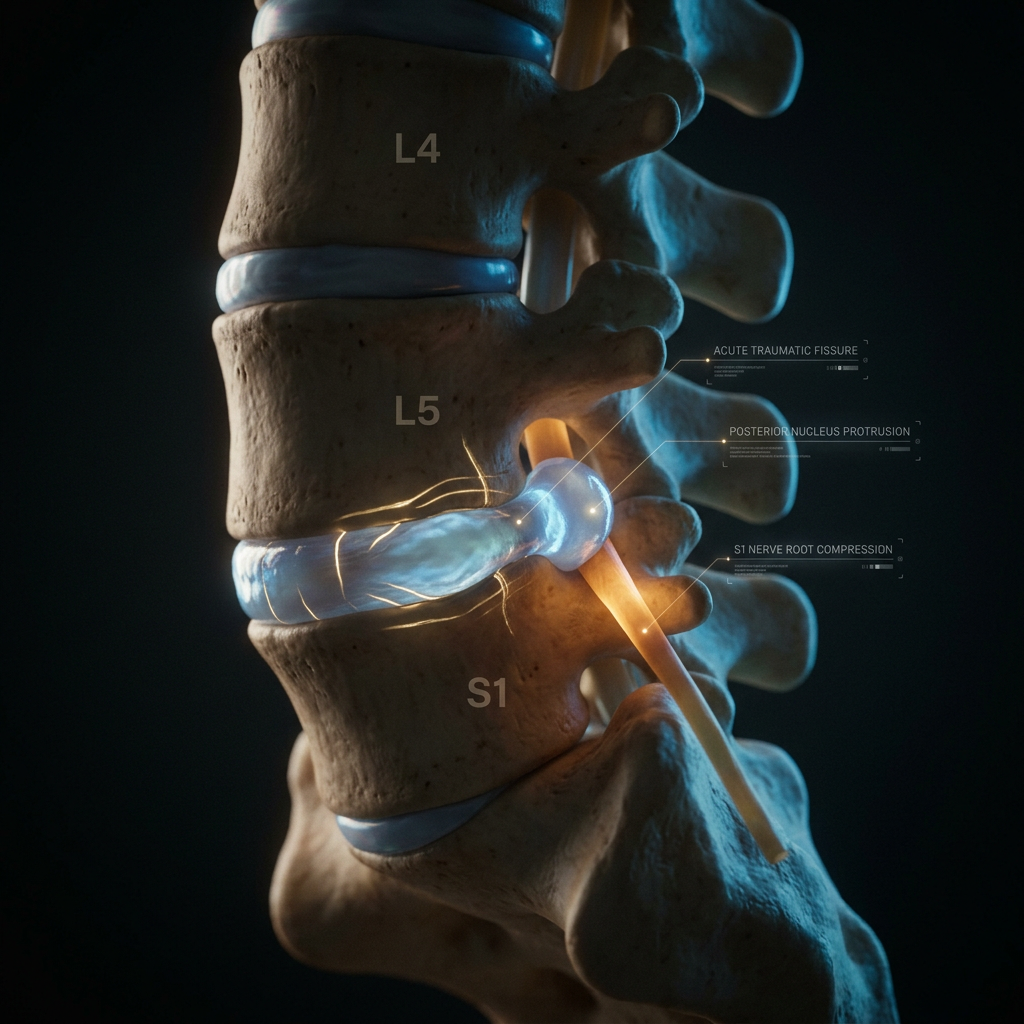
Also known as: Herniated Disc, Slipped Disc, Lumbar HNP, Sciatica from Car Accident A lumbar disc injury from an MVA is damage to one of the shock-absorbing discs of the lower back (typically at L4-5 or L5-S1) when axial loading combined with sudden flexion tears the annular fibers and allows the nucleus to herniate against a nerve root. The result, when the sciatic roots are involved, is radiculopathy, leg pain in a distribution pattern that follows the compressed nerve. Roughly 80-90% of lumbar disc herniations improve with conservative care over six to twelve weeks. Deep low back pain combined with sharp, burning, or electrical pain shooting into the buttock, thigh, calf, and sometimes the foot is the classic presentation.
Coughing, sneezing, bending forward, and prolonged sitting worsen it; lying down usually helps. Many patients pinpoint the moment their leg pain first appeared (often days or weeks after the accident) when they bent to put on shoes or stood up from a low chair. The accident is the clinically and legally relevant cause. Flexion-distraction (the Cox technique) is the cornerstone of our approach, it has specific evidence for lumbar radiculopathy.
McKenzie directional exercises centralize leg symptoms. Neural mobilization for the sciatic nerve, motor control exercise, and spinal decompression for acute radicular pain complete the protocol. When pain is severe, we co-manage with pain management for epidural steroid injections and coordinate with orthopedics or neurosurgery if red flags emerge. Neurologic findings are documented carefully at every visit.
We may recommend: flexion-distraction/Cox, spinal decompression, McKenzie protocol, Class IV laser, corrective exercise, DNS, TENS/e-stim Seek immediate care if: You develop saddle anesthesia, loss of bladder or bowel control, rapidly progressive leg weakness, or foot drop: these may indicate cauda equina syndrome and require emergency surgical evaluation.
How We Can Help
At Gentle Care Chiropractic, we take a multi-disciplinary approach, addressing the root cause of your condition, not just the symptoms.
Chiropractic Adjustments
Precise spinal and joint corrections to restore alignment, relieve nerve pressure, and reduce pain. Manual or instrument-assisted based on your needs.
Massage Therapy
Therapeutic massage releases muscle tension, improves circulation to injured tissue, and works synergistically with adjustments for faster recovery.
Physical Rehabilitation
Customized exercise programs strengthen supporting muscles, restore range of motion, and help prevent future flare-ups.
Laser Therapy
Cold laser therapy uses targeted light wavelengths to stimulate cellular healing, reduce inflammation, and relieve deep tissue pain without heat or discomfort.
Electrical Stimulation
E-stim therapy reduces pain and muscle spasm, improves circulation, and supports the healing process. Especially effective for acute injuries.
Personalized Care Plan
Every patient is different. We combine these therapies in a plan tailored to your diagnosis, goals, and lifestyle for the best possible outcome.
Frequently Asked Questions
Common questions about Lumbar Disc Injury/Herniation from MVA, answered by our team.
My leg pain started a week after the crash when I bent down to put on my shoes — did I just re-injure myself?
Almost certainly not. The annular tear in the disc occurred at impact; the nerve root compression often declares itself later, when a routine movement creates just enough additional pressure to push an already compromised disc into symptomatic territory. Bending forward to put on shoes is one of the most common triggers for lumbar disc herniation symptoms to first fully manifest, because forward flexion loads the posterior disc space. The accident remains the causative event — your clinician and attorney will document the mechanism and timeline to establish that connection clearly.
What is sciatica, and is that what I have if my pain goes down my leg?
Sciatica is the common term for pain that travels from the lower back through the buttock and down the leg along the sciatic nerve's path. It's a symptom, not a diagnosis on its own. When a lumbar disc herniates (typically at L4-5 or L5-S1), the herniated material presses on one of the nerve roots that form the sciatic nerve, producing that characteristic shooting, burning, or electrical pain into the buttock, thigh, calf, and sometimes the foot. A classic additional clue: the specific distribution tells us which level is involved — L4 radiculopathy typically involves the inner calf and shin, L5 the outer calf and top of the foot, S1 the heel and outer foot.
What is flexion-distraction technique and why is it used for a herniated disc?
Flexion-distraction (the Cox technique) is a hands-on, low-force procedure performed on a specialized table that gently distracts the lumbar spine while the clinician focuses traction and movement on the specific herniated segment. It creates a negative intradiscal pressure that draws the herniated material away from the nerve root, reduces inflammation around the nerve, and restores normal spinal motion without compressing or loading the disc further. It has good clinical evidence specifically for lumbar radiculopathy and disc herniation. Patients usually notice a gradual centralization of leg pain — symptoms moving from the foot toward the back — which is a reliable sign that the approach is working.
If 80–90% improve without surgery, how will I know if I'm in the group that might need it?
The clearest surgical indicators are progressive motor weakness (foot drop, inability to extend the knee, worsening quickly), loss of bladder or bowel control, and unrelenting pain that fails to respond to six to twelve weeks of quality conservative care. Those are the non-negotiable triggers for surgical evaluation. For everyone else — even patients with significant leg pain — conservative care deserves a genuine trial first. We track neurological findings (reflexes, muscle strength, sensation) at every visit specifically to catch progression early. If your findings are stable or improving, conservative care continues. If neurological deficits are actively worsening, we refer immediately.
Will a herniated disc from a car accident show on MRI, and do I need one right away?
MRI is the most sensitive imaging study for lumbar disc herniation and will typically show disc pathology clearly. However, we don't always need one immediately. If your symptoms are consistent with disc herniation (leg pain in a dermatomal pattern, worsened by sitting and flexion, improved by lying down) without neurological deficits, a clinical trial of conservative care for four to six weeks is reasonable before ordering imaging. MRI is ordered sooner if neurological deficits are present, if symptoms are severe, or if the clinical picture is unclear. When imaging is needed, it gets billed through your PIP coverage, and we coordinate the referral and communicate findings with your care team.
Ready to Find Relief?
You don't have to live with Lumbar Disc Injury/Herniation from MVA. Our team at Gentle Care Chiropractic is here to help you recover and get back to doing what you love.