

Spondylolisthesis and Spondylolysis
Expert care for Spondylolisthesis and Spondylolysis at Gentle Care Chiropractic in West Linn, Oregon.
Understanding Spondylolisthesis and Spondylolysis
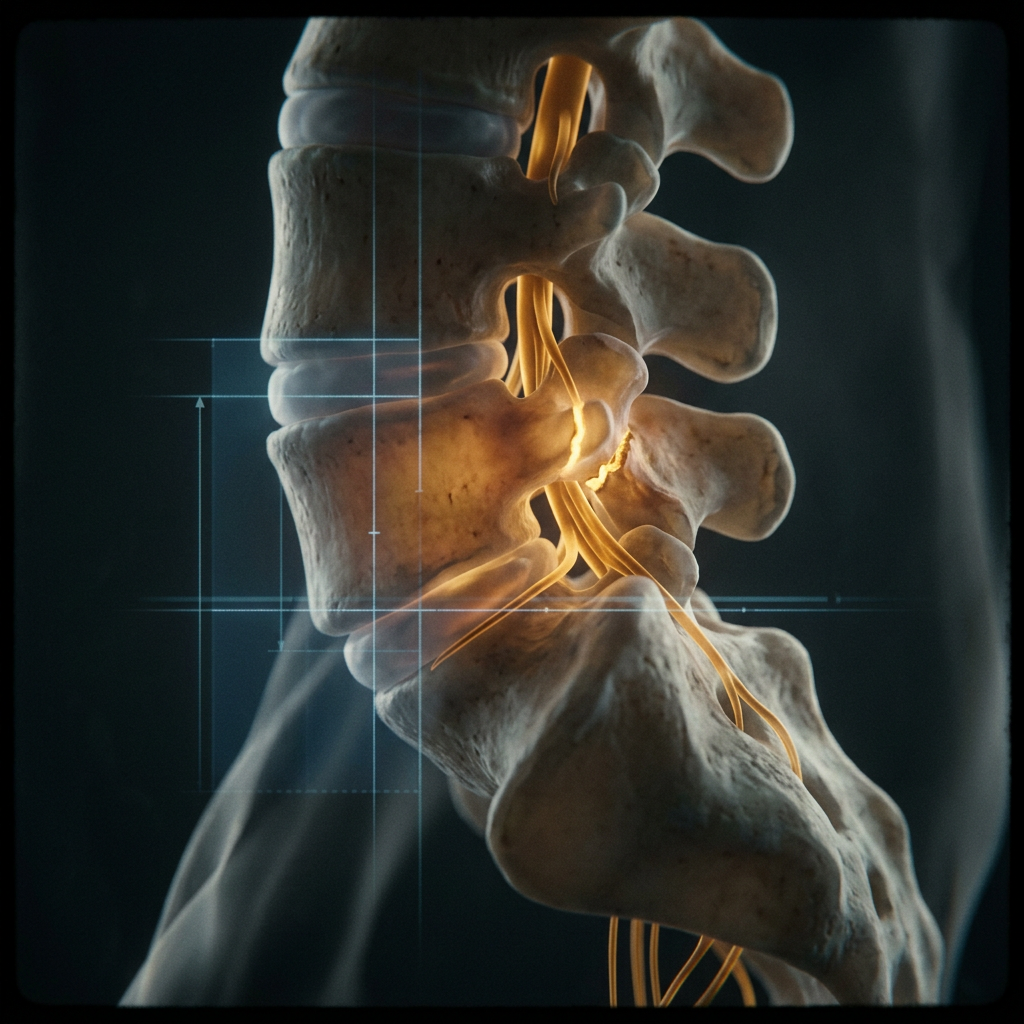
Also known as: Pars Defect, Slipped Vertebra, Stress Fracture of the Spine Spondylolysis is a stress fracture of the pars interarticularis (a small bony bridge at the back of each vertebra) most often at L5. When that fracture allows one vertebra to slip forward on the one below, the condition is called spondylolisthesis (from the Greek for "vertebra" and "to slip"). The slippage is graded one through four; grade one, the most common, is often well-managed conservatively. Adolescent athletes (gymnasts, football linemen, divers, dancers) and older adults with degenerative joint changes represent the two main patient groups, and their presentations differ enough that care has to be tailored accordingly.
In young athletes, the pain is typically a deep, persistent low back ache that worsens with extension activities, standing, arching backward, running downhill. Hamstring tightness is a hallmark finding, almost a reflex response to the instability at the base of the spine. In older adults, the pattern looks more like stenosis, with leg fatigue and claudication. Pain often improves with rest, forward-flexed positions, and abdominal bracing.
In young athletes, repetitive hyperextension sports are the primary cause. In older adults, degenerative disc and facet changes allow gradual slippage. Genetics matter, as do a history of back trauma and sudden loading events. Our care is deliberately flexion-biased.
We avoid aggressive extension-based manipulation at the affected level, using instead gentle mobilization, Activator, or drop-table techniques above and below the slippage to restore regional motion without provoking the unstable segment. Core stabilization is essential, McGill "Big 3," dead bugs, and deep abdominal bracing provide the dynamic stability the pars defect cannot. Hamstring and hip flexor mobility reduces pelvic tension that loads the segment. Class IV laser can assist healing in active stress reactions where there is bone marrow edema.
We co-manage with orthopedics for grade 3-4 slippage, neurological progression, or failed conservative care. We may recommend: Activator, flexion-distraction/Cox, corrective exercise, McKenzie directional exercises, Class IV laser, myofascial release, posture program Seek immediate care if: You develop progressive leg weakness, bowel or bladder changes, saddle numbness, or a sudden marked increase in pain: these can indicate advancing slippage or nerve compression requiring urgent evaluation.
How We Can Help
At Gentle Care Chiropractic, we take a multi-disciplinary approach, addressing the root cause of your condition, not just the symptoms.
Chiropractic Adjustments
Precise spinal and joint corrections to restore alignment, relieve nerve pressure, and reduce pain. Manual or instrument-assisted based on your needs.
Massage Therapy
Therapeutic massage releases muscle tension, improves circulation to injured tissue, and works synergistically with adjustments for faster recovery.
Physical Rehabilitation
Customized exercise programs strengthen supporting muscles, restore range of motion, and help prevent future flare-ups.
Laser Therapy
Cold laser therapy uses targeted light wavelengths to stimulate cellular healing, reduce inflammation, and relieve deep tissue pain without heat or discomfort.
Electrical Stimulation
E-stim therapy reduces pain and muscle spasm, improves circulation, and supports the healing process. Especially effective for acute injuries.
Personalized Care Plan
Every patient is different. We combine these therapies in a plan tailored to your diagnosis, goals, and lifestyle for the best possible outcome.
Frequently Asked Questions
Common questions about Spondylolisthesis and Spondylolysis, answered by our team.
My teenager was just diagnosed with a pars stress fracture. Does this mean they can never return to their sport?
Almost certainly not. Return-to-sport rates for adolescent athletes with spondylolysis are remarkably high — research shows over 95% of young athletes with this diagnosis successfully return to their pre-injury level of competition with conservative care. The typical timeline is three to six months, depending on the severity and how early care begins. The initial phase involves activity modification away from extension-heavy loading (no arching backward, no overhead lifts), followed by structured core stabilization and a phased return guided by symptom response. Surgery is genuinely rare for this diagnosis in young athletes and shouldn't be the default expectation.
What is the pars interarticularis, and why does it stress-fracture in young athletes?
The pars interarticularis is a small bridge of bone at the back of each vertebra connecting the upper and lower facet joints. It's mechanically vulnerable because it's the point where extension and rotation forces concentrate in the lumbar spine, and in growing adolescents the bone is still maturing. Athletes in extension-heavy sports — gymnastics, diving, football linemen, dance — subject this area to thousands of repetitive loading cycles. It's essentially a fatigue fracture, the same mechanism as a shin stress fracture in a runner. The good news is that with early recognition and appropriate rest from provocative activities, many cases heal with bone union.
If I have grade 1 spondylolisthesis, should I be worried about the vertebra slipping further?
Grade 1 — meaning the vertebra has slipped less than 25% over the one below — is by far the most common presentation and is generally very manageable conservatively. Progression to a higher grade is not inevitable; in adults with degenerative spondylolisthesis, significant progression is uncommon with appropriate care and lifestyle management. The key protective factors are core stabilization (which provides dynamic stability the bony architecture can't), avoiding excessive extension loading, and maintaining a healthy weight. We monitor with periodic reassessment, and any changes in neurological symptoms would prompt imaging review.
My hamstrings are extremely tight. Is that connected to the spondylolisthesis?
Yes — tight hamstrings are one of the most consistent findings in spondylolisthesis, to the point that unexplained hamstring tightness in a young athlete should prompt screening for this diagnosis. The hamstrings attach to the bottom of the pelvis and, when tight, tilt it posteriorly as a reflexive protective mechanism, reducing the lumbar extension that would stress the unstable segment. It's the body's unconscious stabilizing strategy. Aggressive isolated hamstring stretching without addressing the underlying instability often doesn't hold. We treat the hamstrings as part of a comprehensive pelvic and core stabilization program rather than in isolation.
Why is it important to avoid extension exercises with this condition?
The pars stress fracture and spondylolisthesis are both worsened by spinal extension — arching backward narrows the posterior elements and increases compressive load through the pars interarticularis, exactly the motion that caused the problem in the first place. Extension-based exercises like back extensions, press-ups, and certain yoga backbends can provoke pain and potentially advance slippage. We favor a flexion-biased approach: pelvic tilts, dead bugs, and bracing exercises that stabilize the lumbar spine in a neutral-to-slightly-flexed position. This keeps the affected segment protected while building the muscular support it needs.
Ready to Find Relief?
You don't have to live with Spondylolisthesis and Spondylolysis. Our team at Gentle Care Chiropractic is here to help you recover and get back to doing what you love.