

Thoracic Sprain/Strain and Costovertebral Dysfunction
Expert care for Thoracic Sprain/Strain and Costovertebral Dysfunction at Gentle Care Chiropractic in West Linn, Oregon.
Understanding Thoracic Sprain/Strain and Costovertebral Dysfunction
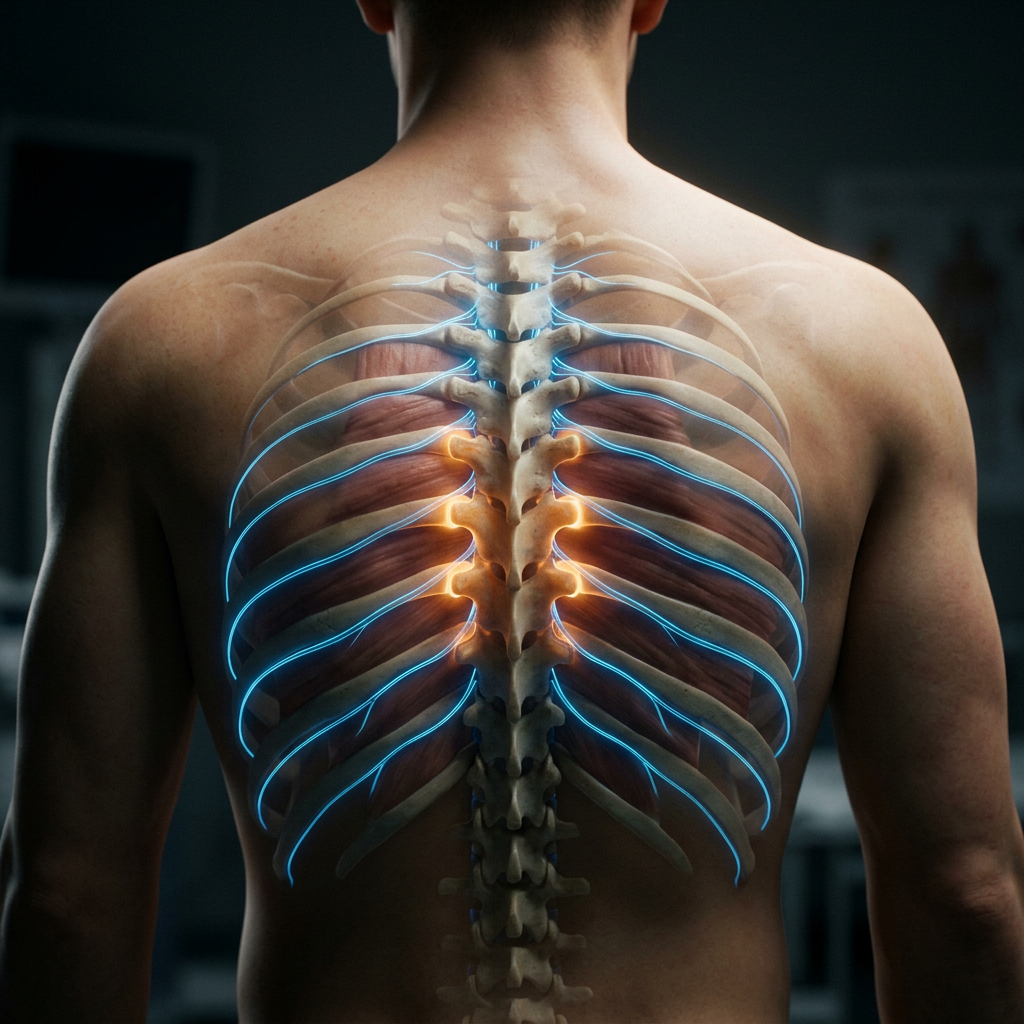
Also known as: Mid-Back Sprain, Seatbelt Injury, Rib Joint Injury, Upper Back Pain After Car Accident The thoracic spine is built for stability, which means when it gets injured, it usually requires a high-energy event to do it, and the shoulder strap of the seatbelt provides exactly that kind of force during a frontal crash. Thoracic sprain/strain involves injury to the ligaments and muscles of the mid-back. Costovertebral dysfunction refers to a mechanical problem at the small joints where the ribs meet the thoracic vertebrae. Both commonly occur together after an MVA, and together they produce a characteristic pattern of interscapular pain that can easily be mistaken for cardiac symptoms.
Sharp, stabbing pain between the shoulder blades or along the spine, worsened by deep breath, laugh, cough, or sneeze, is the hallmark. Many patients describe it as "a knife in my back" or feeling like "a rib is out. " Pain may refer to the anterior chest wall. The seatbelt concentrates decelerative force diagonally across the thoracic spine while the body is driven forward into the restraint, and side-impact crashes translate lateral force directly through the rib cage.
After ruling out fracture or pulmonary issues and documenting findings, we typically perform thoracic and rib-specific manipulation or mobilization, soft-tissue therapy to the rhomboids, mid-traps, and paraspinals, diaphragmatic breathing retraining, and Class IV laser for residual inflammation. Postural correction and scapular strengthening prevent recurrence. Most patients improve meaningfully within four to six weeks. We coordinate with your PCP if chest pain symptoms need cardiac or pulmonary clearance.
We may recommend: diversified adjustments, Activator, myofascial release, Graston/IASTM, trigger point therapy, Class IV laser, corrective exercise Seek immediate care if: You have shortness of breath, coughing blood, crushing chest pain, pain radiating to the jaw or left arm, or severe midline spinal tenderness: these require emergency cardiac and pulmonary evaluation before chiropractic care begins.
How We Can Help
At Gentle Care Chiropractic, we take a multi-disciplinary approach, addressing the root cause of your condition, not just the symptoms.
Chiropractic Adjustments
Precise spinal and joint corrections to restore alignment, relieve nerve pressure, and reduce pain. Manual or instrument-assisted based on your needs.
Massage Therapy
Therapeutic massage releases muscle tension, improves circulation to injured tissue, and works synergistically with adjustments for faster recovery.
Physical Rehabilitation
Customized exercise programs strengthen supporting muscles, restore range of motion, and help prevent future flare-ups.
Laser Therapy
Cold laser therapy uses targeted light wavelengths to stimulate cellular healing, reduce inflammation, and relieve deep tissue pain without heat or discomfort.
Electrical Stimulation
E-stim therapy reduces pain and muscle spasm, improves circulation, and supports the healing process. Especially effective for acute injuries.
Personalized Care Plan
Every patient is different. We combine these therapies in a plan tailored to your diagnosis, goals, and lifestyle for the best possible outcome.
Frequently Asked Questions
Common questions about Thoracic Sprain/Strain and Costovertebral Dysfunction, answered by our team.
My mid-back pain is worst when I take a deep breath — is that normal after a crash?
Yes, and it's one of the most characteristic features of a costovertebral joint injury. The small joints where your ribs meet the thoracic vertebrae are mechanically loaded with every breath, so when they're injured or restricted after a crash, deep breathing, coughing, laughing, and sneezing produce sharp, often startling pain. This is different from a muscle strain, which is more of a constant ache. Many patients come in saying it feels "like a rib is out," and functionally, that description captures the joint restriction quite well. Rib-specific manipulation typically produces rapid improvement in breathing-related pain.
Can this type of pain be mistaken for a heart attack or lung problem?
It can, and it absolutely should be ruled out first. Interscapular and anterior chest pain after an MVA can mimic cardiac symptoms, and we take that seriously — if you have crushing chest pressure, pain radiating to the jaw or left arm, shortness of breath at rest, or any symptom that feels cardiovascular, you need emergency evaluation before anything else. Once cardiac and pulmonary causes are cleared, thoracic sprain/costovertebral dysfunction becomes the working diagnosis. The distinguishing feature clinically is that musculoskeletal pain is reproducible by pressing on specific spinal levels or rib joints — cardiac pain is not.
Why is my mid-back injured if the seatbelt was across my chest and shoulder?
The shoulder belt runs diagonally from the upper chest down across the thorax and anchors at the opposite hip — during a frontal collision, the decelerating body is driven hard into this diagonal restraint. That concentrated force passes directly through the rib cage and into the thoracic spine and costovertebral joints. Side-impact collisions add a lateral component that loads the rib cage and mid-back asymmetrically. The thoracic spine was built for stability rather than mobility, which means it absorbs and transfers crash energy to the costovertebral joints rather than dissipating it through movement.
How long does thoracic sprain/strain and costovertebral dysfunction take to resolve?
Most patients feel meaningful improvement within four to six weeks of targeted thoracic and rib manipulation, soft-tissue therapy to the rhomboids and paraspinals, and breathing retraining. Costovertebral joints respond well to specific manipulation — often more quickly than cervical injuries — because the joint can be directly and precisely mobilized. If pain persists, we reassess for rib stress fractures (which X-ray can sometimes miss) or an unidentified thoracic disc problem, and coordinate imaging accordingly.
Is it safe for me to go back to work if my job involves sitting at a desk most of the day?
Desk work is generally manageable, but prolonged static sitting compresses the thoracic spine and restricts rib mobility, which can aggravate both the sprain and the costovertebral joints. We'll recommend frequent position changes, a lumbar support to reduce thoracic rounding, and specific mobilization exercises you can do at your desk. Brief movement breaks every 30–45 minutes make a larger difference than any single exercise. If your job requires heavy lifting, overhead work, or long hours in a fixed position, we'll document functional restrictions for your employer and insurance adjuster.
Ready to Find Relief?
You don't have to live with Thoracic Sprain/Strain and Costovertebral Dysfunction. Our team at Gentle Care Chiropractic is here to help you recover and get back to doing what you love.