
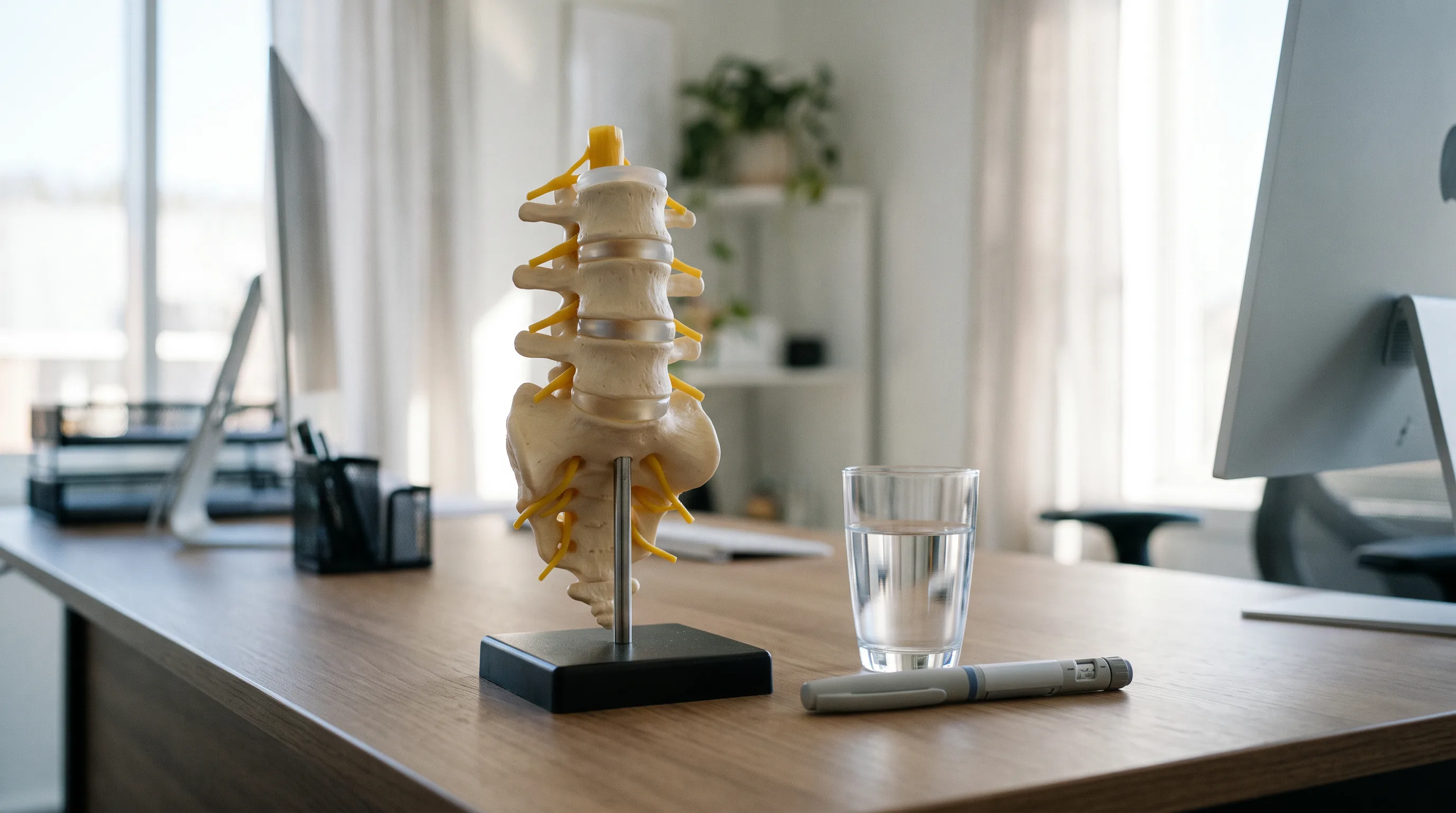
Here is something I am seeing in my clinic more often: a patient comes in after six months on semaglutide or tirzepatide. They have lost thirty, forty, sometimes fifty pounds. They feel better in almost every way. But their knees hurt. Their lower back aches in ways it did not before. Their shoulders feel unstable. And they cannot understand why losing weight, which is supposed to be good for joints, is making them feel worse.
The answer has to do with how GLP-1 drugs cause weight loss, what that weight is composed of, and what it leaves behind in the musculoskeletal system. If you are on a GLP-1 receptor agonist and experiencing joint pain after weight loss, this post is for you.
What GLP-1 Drugs Actually Do to Your Body Composition
GLP-1 (glucagon-like peptide-1) receptor agonists work primarily by slowing gastric emptying, increasing satiety signaling in the hypothalamus, and reducing appetite. The clinical result is a significant reduction in caloric intake, which produces meaningful weight loss. The STEP and SURMOUNT trials confirmed this across thousands of patients: semaglutide and tirzepatide reliably produce 15 to 22 percent body weight reduction over 72 weeks.
What those headlines do not always mention is the composition of that weight loss. Multiple body composition studies, including work from the STEP 1 trial published in the New England Journal of Medicine, found that roughly 25 to 40 percent of weight lost on GLP-1 drugs in patients who do not exercise comes from lean mass, including muscle tissue. The rest is fat. For a 200-pound person who loses 40 pounds, that could mean 10 to 16 pounds of lost muscle alongside 24 to 30 pounds of lost fat.
This matters enormously for the musculoskeletal system.
Why Muscle Loss Destabilizes Joints and the Spine
Joints do not hold themselves together by bone geometry alone. They depend on surrounding musculature to distribute load, absorb shock, and maintain alignment through dynamic movement. When muscle mass drops quickly, without being replaced by trained, functional strength, that stabilizing force disappears.
In the lower back, the deep stabilizers including the multifidus, rotatores, and quadratus lumborum are small muscles that resist rotational and compressive forces on the lumbar spine. If those muscles atrophy, the passive stabilizers (ligaments, discs, facet joints) absorb forces they were not designed to handle chronically. This is one mechanism behind what I think of as GLP-1 musculoskeletal syndrome: patients who lose weight rapidly without strength training, then develop new back pain, hip pain, or knee instability.
In the knee, the quadriceps are the primary shock-absorbing muscles for the tibiofemoral joint. Quadriceps weakness is one of the strongest modifiable predictors of knee osteoarthritis progression. Losing quadriceps mass while also losing body weight creates a complicated picture: less compressive load from above, but less muscular support from around the joint. For some patients, that net result is increased pain, not less.
There is also evidence that GLP-1 receptors are expressed in articular cartilage and synovial tissue. Early preclinical and observational data suggest these receptors may have anti-inflammatory effects within joint tissue, which is a genuinely interesting avenue of research. But at the clinical level, the dominant story I am seeing is not inflammation. It is stability and biomechanics.
The Gait and Posture Changes Nobody Warns You About
Rapid weight loss also changes how you move. This sounds obvious but its implications are underappreciated. After decades of moving through the world at a certain weight, your nervous system has calibrated proprioceptive patterns, gait mechanics, and postural strategies around that body. Remove thirty to fifty pounds, often asymmetrically from trunk and limbs, and those movement patterns become temporarily mismatched to your new body.
I think of it as a recalibration lag. Your brain is still organizing your spine and pelvis around a body that no longer exists, while simultaneously managing the reduction in muscle support. This can produce new areas of shear force on facet joints, altered spinal curves, and unfamiliar loading patterns at the hip and sacroiliac joint. Patients sometimes describe it as feeling unsteady, or like their back “doesn’t know where it is.” That is not far from physiologically accurate.
What This Is Not, and Who Should Not Ignore These Symptoms
Joint and spine pain during rapid GLP-1 weight loss is not automatically benign, and I want to be clear about the differential here.
Bone loss is a real concern. GLP-1 drugs have been associated with reductions in bone mineral density in some studies, likely because adipose tissue is a source of estrogen and mechanical load, both of which stimulate bone remodeling. For postmenopausal women in particular, rapid weight loss from any cause, including GLP-1 drugs, can accelerate bone density decline. If you are on a GLP-1 drug, your prescribing physician should be monitoring bone health, especially if you are female and over 50.
Stress fractures in the foot and hip have been reported in patients with rapid GLP-1-associated weight loss who simultaneously increased their physical activity. If your joint pain is sharp, focal, and worsens with weight bearing, do not assume it is musculoskeletal tightness. Get imaging.
New joint pain in the context of significant immune or metabolic shifts can also reflect underlying inflammatory arthropathy, though the connection to GLP-1 drugs specifically remains under study.
For the majority of patients I see, however, the presentation is muscular deconditioning plus biomechanical recalibration, and that is very treatable.
What Chiropractic and Integrated Care Actually Offers Here
What I do in this context is not dramatically different from what I do for any patient with spine instability and altered movement patterns. I do a detailed functional assessment: how is their lumbar curve loading under their new weight distribution? Where are they compensating? What muscles have become inhibited or lengthened beyond their functional range?
Spinal manipulation in this population is targeted at restoring segmental mobility where facet joints have become restricted from altered loading, often in the lower thoracic and lumbopelvic region. Joint mobilization at the hip and sacroiliac joint addresses the gait adaptation patterns. Soft tissue work, whether myofascial release or instrument-assisted therapy, helps address trigger points that form in muscles working harder to compensate for weakened neighbors.
But the most important thing I do is make a specific, progressive resistance exercise prescription, ideally in collaboration with the patient’s prescribing physician and a physical therapist. Preserving and rebuilding lean muscle while on GLP-1 therapy is not optional if you want the weight loss to benefit your joints and spine over the long term. The research on this is consistent: GLP-1 drug users who incorporate structured resistance training lose substantially less lean mass than those who do not, and their functional outcomes are better.
We also look at nutrition. Adequate dietary protein intake (the current evidence-informed target is around 1.2 to 1.6 grams per kilogram of body weight per day) is essential to preserve muscle during the caloric deficit GLP-1 drugs create. This is a conversation that should be happening between patients and their prescribers, but it is often not.
What This Treatment Cannot Do
Chiropractic care in this context will not stop muscle loss if you remain in a severe caloric deficit without resistance exercise. It will not address the underlying bone density changes that require medical monitoring and potentially pharmacological intervention. And it will not substitute for a conversation with your prescribing physician about your body composition trajectory.
If you are experiencing significant joint instability, focal bone pain, or neurological symptoms like numbness or weakness alongside your GLP-1 therapy, those need to be evaluated medically before we start a manual therapy course.
Frequently Asked Questions
Can Ozempic or Mounjaro cause joint pain? GLP-1 drugs like semaglutide (Ozempic, Wegovy) and tirzepatide (Mounjaro, Zepbound) can indirectly cause joint pain, most often through rapid loss of lean muscle mass that reduces joint stability. This is especially common in patients who lose weight quickly without incorporating resistance training. The joint pain is typically diffuse and related to altered biomechanics rather than a direct drug effect on joint tissue.
Why does my back hurt more after losing weight on GLP-1 medication? This is a recognized clinical pattern. Rapid weight loss reduces the stabilizing muscle mass around your spine, creates gait and posture changes your nervous system must recalibrate to, and can alter spinal loading patterns. Many patients find that their back pain from carrying excess weight is replaced by a different kind of back pain from reduced core stability. Chiropractic care paired with progressive resistance training typically resolves this over several months.
Is it safe to get chiropractic adjustments while on semaglutide? Yes, for most patients. There are no specific contraindications to chiropractic care from GLP-1 drug therapy itself. If you have had rapid bone loss or are at elevated osteoporosis risk, your chiropractor should use lower-force techniques and may request bone density information from your physician before proceeding.
How much protein should I eat to preserve muscle on a GLP-1 drug? The current evidence supports 1.2 to 1.6 grams of protein per kilogram of actual body weight per day as a target for preserving lean mass during GLP-1-associated weight loss. Because GLP-1 drugs suppress appetite significantly, hitting these protein targets requires deliberate planning, often with high-protein foods prioritized at every meal. Work with your prescribing physician or a registered dietitian on specifics.
Can a chiropractor help me if I’m experiencing knee pain after weight loss? Yes. Knee pain after GLP-1 weight loss often relates to quadriceps weakness and altered gait mechanics rather than structural joint damage. A chiropractor can assess your lower limb biomechanics, provide joint mobilization and soft tissue therapy, and coordinate with physical therapy for quadriceps strengthening. This combination addresses both the symptomatic relief and the underlying stability deficit.
If you have questions or want to find out whether musculoskeletal support during GLP-1 therapy is a good fit for your care plan, we’re easy to reach. That’s what we’re here for.
Dr. Tristan Santiago Maceiras is a Doctor of Chiropractic at Gentle Care Chiropractic in West Linn, Oregon, specializing in musculoskeletal medicine, MVA recovery, and integrated care.
Dealing with this in West Linn, Lake Oswego or Oregon City?
Same-week appointments. PIP and most insurance accepted.