
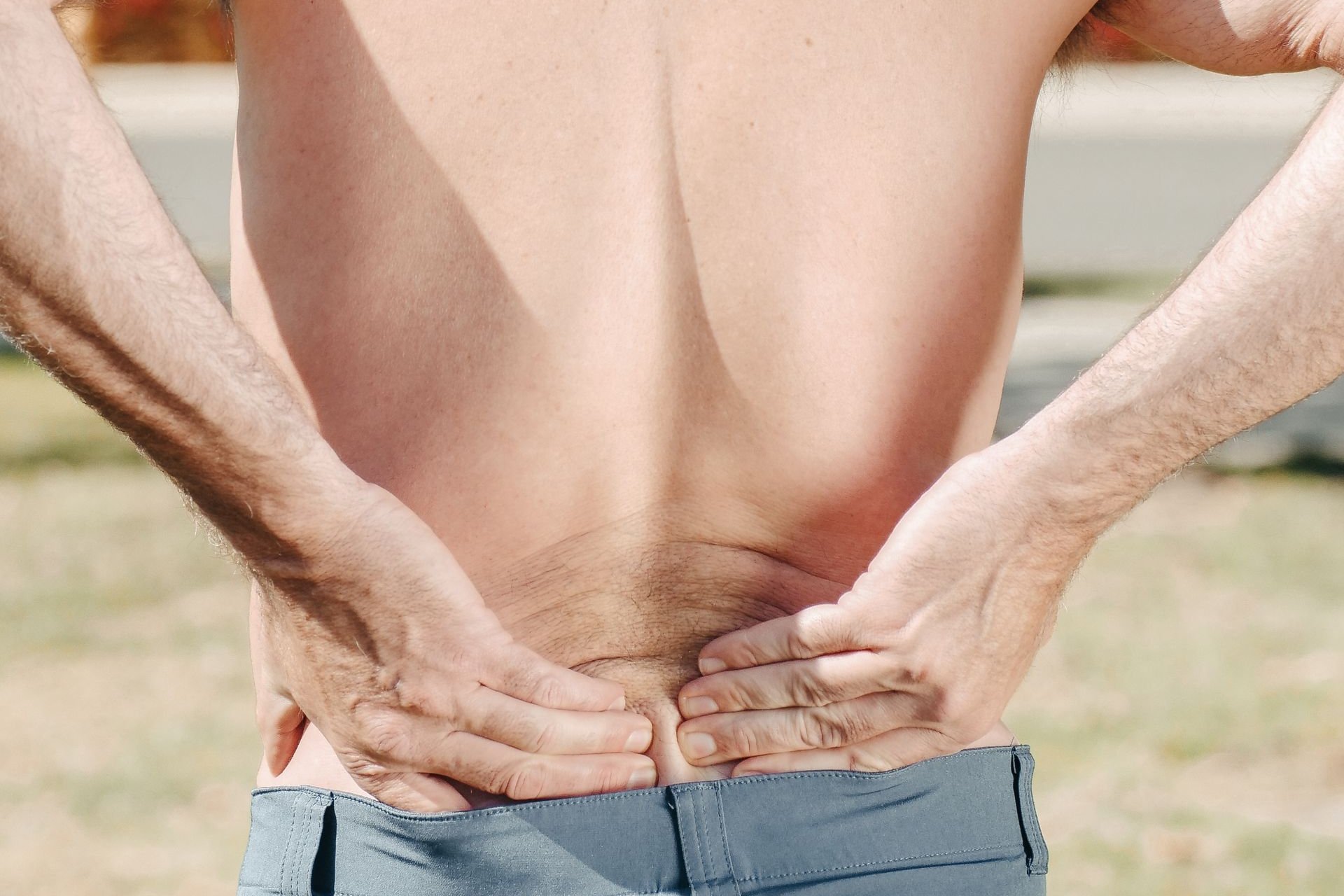
Most people expect neck pain after a crash. Fewer expect to wake up two days later unable to bend over to tie their shoes. Low back pain is one of the most common complaints we see after a motor vehicle accident, and it is also one of the most commonly ignored. People blame it on sleeping wrong, on stress, or on “just being sore.”
Sometimes it is just soreness. Sometimes it’s a sprained ligament, an irritated joint, or a disc injury that gets harder to treat the longer it goes unaddressed. Here’s how to tell the difference.
Why a crash hurts the lower back
Your seatbelt holds your pelvis in place, but your torso keeps moving. In a rear-end collision your lumbar spine compresses and then flexes. In a frontal impact it flexes forward hard against the lap belt. In a side impact it bends and twists at the same moment. On top of that, you are probably bracing. Your foot is on the brake, your hands are gripping the wheel, and your muscles are tensed, so the force travels through rigid tissue instead of being absorbed.
Even a low-speed collision can produce forces your back isn’t built to take, and the damage to your car is a poor predictor of the damage to you.
Why the pain often shows up days later
Two things delay the pain:
- Adrenaline. Right after a crash, stress hormones raise your pain threshold. That’s useful at the scene and misleading afterward.
- Inflammation. Strained muscles, ligaments, and joints swell over the following 24–72 hours. The swelling is what turns “a little stiff” into “I can’t get out of bed.”
So “I felt fine at the scene” is normal. It doesn’t mean you weren’t injured.
The most common lower back injuries after an accident
- Lumbar sprain/strain: overstretched or torn muscles and ligaments. The most common injury, usually felt as aching, stiffness, and spasm. → Lumbar sprain/strain from MVA
- Facet joint irritation: the small joints at the back of each vertebra get jammed or inflamed. Pain is often sharper when leaning back or twisting.
- Sacroiliac (SI) joint injury: pain low on one side, near the dimple above your buttock, often worse when you climb stairs or stand up from sitting. → SI joint injury from MVA
- Disc injury or herniation: the cushion between vertebrae bulges or tears. It can cause deep back pain, and if it presses on a nerve, pain that runs down the leg. → Lumbar disc injury from MVA
- Sciatica: nerve irritation causing burning, shooting pain, numbness, or tingling down the back of the leg. → Sciatica
Red flags: go to the ER, not the chiropractor
Get emergency care right away if you have any of these after a crash:
- Loss of bladder or bowel control, or new trouble urinating
- Numbness in the groin or inner thighs (“saddle” numbness)
- Weakness in a leg or foot that is getting worse, or a foot that drags
- Severe pain after a high-speed or rollover crash, or any suspicion of a fracture
- Fever, or pain that is severe and constant even when lying perfectly still
These can signal nerve compression or a fracture that needs immediate medical attention. Once those are ruled out, we’re glad to take over your recovery care.
When to get evaluated (sooner than you think)
Book an exam if any of these are true:
- Your back pain started within a few days of the accident
- Pain travels into your hip, buttock, or leg
- Sitting, driving, or bending is noticeably harder than before the crash
- You’re sleeping badly because of the pain
- It isn’t clearly improving after a week
An early exam does two things. Treatment can start before stiffness and guarding become a pattern, and you get a medical record that connects your symptoms to the accident date. That record matters if an insurance claim is ever questioned.
How we treat post-accident back pain at Gentle Care
- A thorough exam: orthopedic and neurological testing, range-of-motion measurements, and digital X-rays in the clinic when they are needed. If your symptoms suggest a disc or nerve problem, we refer you for an MRI.
- A coordinated plan: chiropractic adjustments to restore joint motion, massage therapy for muscle spasm, and therapeutic exercise to rebuild strength and stability, all under one roof.
- Targeted therapies when they fit: electrical stimulation, Class IV laser, SoftWave shockwave therapy, or non-surgical spinal decompression for disc injuries.
- Documentation throughout: every visit is recorded, so your insurer, and your attorney if you have one, can see how your recovery is progressing.
What you can do at home in the first few days
- Keep moving gently. Short, easy walks usually beat bed rest for back strains.
- Use ice for the first 48–72 hours (15–20 minutes at a time), then switch to heat if it feels better.
- Avoid heavy lifting and long periods of sitting. Get up every 30–45 minutes.
- Don’t self-adjust or “crack” your back. It feels like relief, but it can irritate an injured joint. (Here’s why chasing pops isn’t the answer.)
Who pays for it?
In Oregon, your own auto policy’s Personal Injury Protection (PIP) covers at least $15,000 in accident-related medical care, regardless of who caused the crash. That includes chiropractic, massage, and physical therapy. We bill PIP directly. Read the full breakdown in Oregon PIP Explained.
Back pain after a crash? Get it checked
We see accident patients quickly at our West Linn clinic, which serves Lake Oswego, Oregon City, Tualatin, Milwaukie, Happy Valley, and Southwest Portland. Se habla español.
Call (503) 650-2394 or request an appointment online.
This article is for general education and isn’t a substitute for an in-person evaluation. If you have any of the red-flag symptoms above, seek emergency care.
Dealing with this in West Linn, Lake Oswego or Oregon City?
Same-week appointments. PIP and most insurance accepted.