
Here is something that surprises patients almost every time I say it: most people diagnosed with shoulder impingement do not have a structural problem that requires surgery. What they have is a motor control problem. The rotator cuff muscles are not coordinating well enough to keep the humeral head centered in the socket during arm movement, and that is what causes the pinching pain that makes reaching overhead or behind your back feel like a bad idea.
That distinction matters enormously because it changes how we treat it. When shoulder impingement exercises are the right intervention, done in the right sequence, research consistently shows outcomes that rival surgical decompression for the majority of patients.
What Shoulder Impingement Actually Is (and What Most People Get Wrong)
The classic explanation is that the tendon of the supraspinatus gets pinched between the acromion and the humeral head when you lift your arm. That is partly true. But a 2024 systematic review in the British Journal of Sports Medicine reinforced what shoulder specialists have been arguing for years: the subacromial space itself is rarely the primary problem. What drives symptoms in most cases is altered scapular kinematics and rotator cuff underperformance.
In plain terms: if the blade of your shoulder is not rotating upward properly as you raise your arm, the space underneath your acromion gets crowded. The rotator cuff is supposed to counteract this by keeping the humeral head pulled down and centered. When those muscles are weak or poorly recruited, the head rides up, tissues get compressed, and you feel it.
This is why the 2024 clinical practice guideline from the Journal of Orthopaedic and Sports Physical Therapy recommends targeted shoulder impingement exercises addressing scapular control and rotator cuff strengthening as the first-line treatment before any procedural intervention is considered.
Why Standard “Rotator Cuff Exercises” Often Fall Short
The rotator cuff rehab exercises you find in a generic handout tend to be isolated internal and external rotation with a resistance band. These exercises are not wrong. But used alone, they miss two important pieces of the puzzle.
First, the lower trapezius and serratus anterior, the muscles responsible for upward rotation of the scapula, are almost universally undertrained in people with shoulder impingement. A 2023 paper in Physical Therapy and Rehabilitation Journal found that patients who received programs targeting scapular upward rotators alongside rotator cuff strengthening had significantly better outcomes at 12 weeks than those who did rotator cuff work alone.
Second, the order and load progression matter. Starting with heavy resistance before the neuromuscular pattern is established tends to produce substitution, where larger muscles like the upper trapezius or deltoid take over, and the very muscles you need to activate stay quiet. This is what I see in the clinic regularly: patients who have been doing band rotations for weeks but whose lower trap still barely fires when I test it.
The protocol that works addresses both of these issues: establish the scapular pattern first, then load the rotator cuff, then integrate the two into functional movement.
The Shoulder Impingement Exercise Protocol
Before beginning this program, I want to be clear: if you have significant pain at rest, weakness that affects your daily activities, a history of shoulder dislocation, or recent injury, please have an in-person assessment before starting. These exercises are appropriate for most people with subacute or chronic shoulder impingement, but your presentation may require a modified approach.
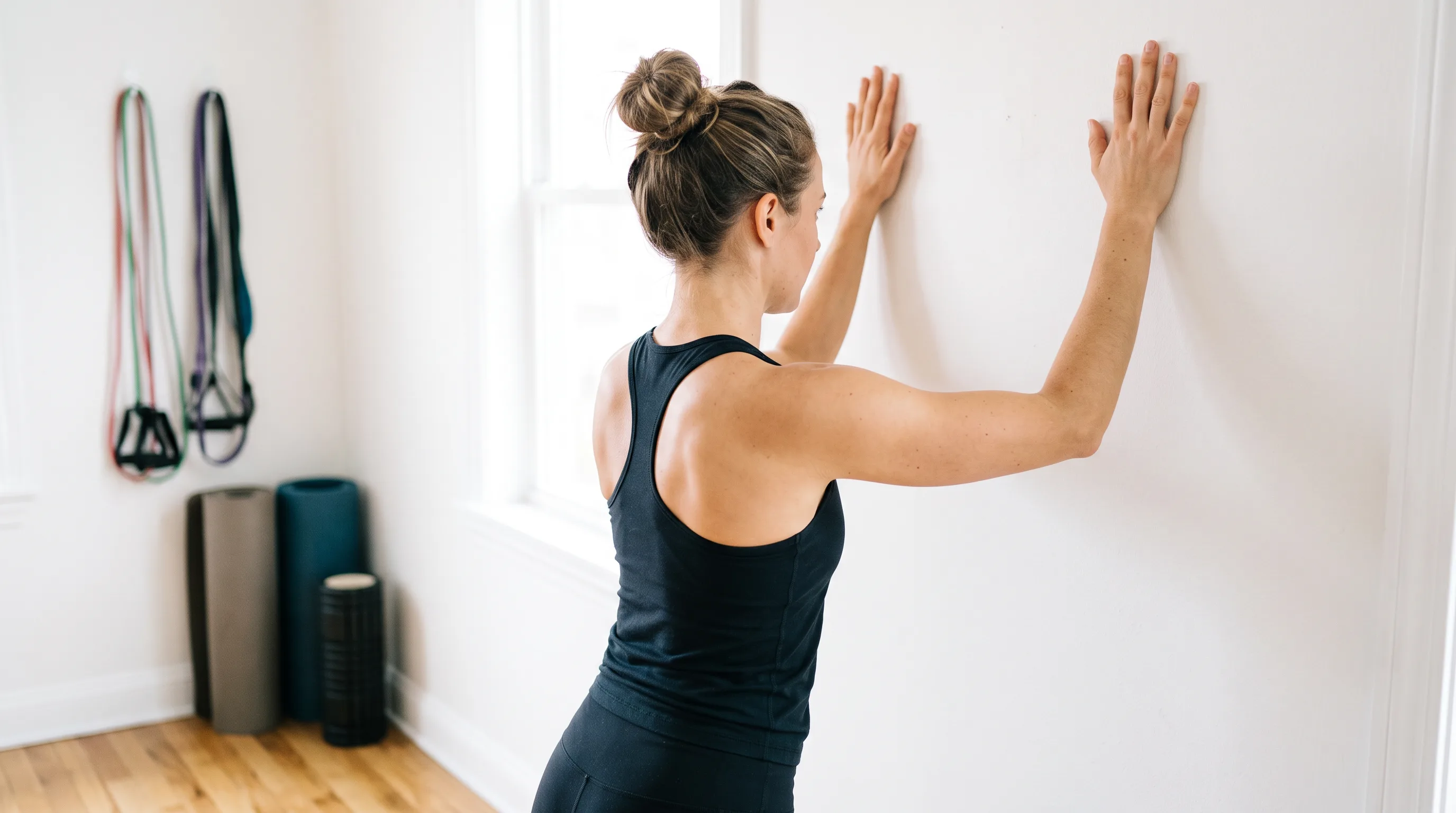
Exercise 1: Wall Slide with Upward Rotation
Starting position: Stand facing a smooth wall. Place both forearms on the wall at shoulder height with elbows bent to 90 degrees.
Movement cue: Slowly slide your arms up the wall while keeping your forearms in contact with the surface. As your arms rise, focus on feeling your shoulder blades rotate upward and away from your spine. Do not let your shoulders shrug toward your ears.
Sets and reps: 3 sets of 10 repetitions. Move slowly, taking 3 seconds up and 3 seconds down.
What to feel: Gentle work along the outer border of your shoulder blade. Light fatigue in the mid-back, not the neck.
What to avoid: Shrugging or arching your lower back to get your arms higher.
Exercise 2: Side-Lying External Rotation
Starting position: Lie on your unaffected side. Bend your top elbow to 90 degrees and rest it against your side. Hold a light weight (0.5 to 2 kg to start, or no weight at all initially).
Movement cue: Keeping your elbow pinned to your side, rotate your forearm upward toward the ceiling. Pause at the top for one second, then lower slowly.
Sets and reps: 3 sets of 15 repetitions. This should feel like mild effort, not a struggle.
What to feel: Work in the back of the shoulder, specifically the posterior capsule area.
What to avoid: Letting the elbow drift forward or allowing the shoulder to roll back to generate momentum.
Exercise 3: Low-to-High Cable or Band Pull (Scapular Row Variation)
Starting position: Anchor a resistance band at low height. Stand facing the anchor point. Hold the band with the arm on your affected side, elbow slightly bent.
Movement cue: Pull the band diagonally across your body from low to high, finishing with your hand at roughly eye level and your elbow flared slightly outward. At the end of the movement, squeeze your shoulder blade down and in, not up.
Sets and reps: 3 sets of 12 repetitions.
What to feel: The posterior shoulder and the lower part of the shoulder blade.
What to avoid: Allowing your upper trapezius to hike your shoulder up during the movement.
Exercise 4: Prone Y Raise
Starting position: Lie face down on a flat surface or a slightly inclined surface if available. Arms are extended overhead in a Y position, thumbs pointing upward.
Movement cue: Keeping your arms straight, lift them off the surface while thinking about pulling your shoulder blades down toward your back pockets. Hold for 2 seconds at the top.
Sets and reps: 3 sets of 10 repetitions. Use no weight initially.
What to feel: Lower trapezius engagement, which will feel like mild burning along the lower inner corner of each shoulder blade.
What to avoid: Craning your neck up or shrugging your shoulders during the lift.
Exercise 5: Supine Shoulder CARs (Controlled Articular Rotations)
Starting position: Lie on your back with your arm at your side.
Movement cue: Slowly move your arm through its full available range: lift it forward and overhead, take it out to the side and back down, completing a large circle. Move at the outer edge of comfortable range without forcing into pain. This is a mobility and motor control exercise, not a strength exercise.
Sets and reps: 5 slow circles in each direction per session. Use this as a warm-up before the exercises above.
What to feel: Progressive engagement through different ranges. Mild effort is fine. Pain is not.
What to avoid: Rushing. The value of this exercise is in the slow, deliberate movement.
What NOT to Do: Common Mistakes and Contraindications
Do not push through sharp pain. A mild ache during exercise is acceptable and expected. Sharp or stabbing pain is a signal to stop and reassess.
Do not ignore the scapula. Exercises that only address the rotator cuff without training scapular upward rotation consistently underperform in clinical outcomes. Both need attention.
Do not load heavily before the pattern is established. Heavier is not better in early shoulder impingement rehab. Proprioception and neuromuscular coordination come before strength. Use loads light enough to maintain perfect form.
Do not use overhead pressing exercises in the early phase. Exercises like military press or upright rows create the same impingement position you are trying to resolve. Save overhead loading for later stages of rehab.
Seek an in-person evaluation if: you have experienced significant trauma to the shoulder, your pain has not responded to conservative care after six to eight weeks, you have weakness in grip or numbness down the arm (which may suggest cervical spine involvement), or your pain is severe at night and disrupts sleep consistently.
A Note for West Linn Patients
In my practice in West Linn, Oregon, I see shoulder impingement presentations across a wide range of activity levels: from desk workers whose posture loads their shoulders asymmetrically across the workday to athletes whose sport demands overhead capacity they have not adequately prepared their shoulders for. What both populations share is that a targeted, progressive exercise program almost always produces meaningful improvement when applied consistently over eight to twelve weeks.
The 2025 Cochrane review on conservative management of rotator cuff related shoulder pain found that exercise-based interventions produced clinically meaningful improvements in pain and function in the majority of participants, with effects maintained at 12-month follow-up. That is a strong outcome for a non-invasive approach with no recovery time.
If you want a movement assessment or a personalized rehab plan, we are easy to reach. That is what we are here for.
Dr. Tristan Santiago Maceiras is a Doctor of Chiropractic at Gentle Care Chiropractic in West Linn, Oregon, specializing in musculoskeletal medicine, rehabilitation, and integrated movement care.
Frequently Asked Questions
How long does shoulder impingement take to heal with exercise? Most patients with subacute or chronic shoulder impingement see meaningful improvement within 6 to 8 weeks of consistent exercise. Full resolution, including return to all activities without restriction, typically takes 10 to 16 weeks depending on severity and adherence. A 2024 JOSPT guideline recommends at least 12 weeks of progressive loading before surgical consultation is considered.
Can shoulder impingement exercises make it worse? Yes, if the wrong exercises are selected or if you load too heavily before the movement pattern is established. Pain during or after exercise that lasts more than an hour, or that is significantly worse the day after training, is a sign you need to reduce load or modify your program. Sharp pain during exercise should prompt you to stop and get an assessment.
What is the difference between shoulder impingement and a rotator cuff tear? Shoulder impingement refers to compression of the subacromial tissues, typically without structural disruption. A rotator cuff tear is a partial or full-thickness disruption of the tendon itself. The two can coexist, and symptoms often overlap. Key distinguishing signs of a significant tear include weakness rather than just pain with resisted movement, and significant pain at night. An MRI or diagnostic ultrasound can differentiate them definitively.
Do I need to see a chiropractor or physical therapist for shoulder impingement, or can I self-treat? Mild, recent-onset shoulder impingement that is clearly related to posture or activity load can often respond to self-directed exercise programs like the one described above. However, if you have had pain for more than four to six weeks, if pain is affecting sleep or daily activities, or if you are unsure of your diagnosis, an in-person evaluation is the more reliable starting point. A proper assessment helps confirm the diagnosis and identify which specific deficits need addressing in your case.
Are shoulder impingement exercises appropriate after rotator cuff surgery? Not without guidance from your surgical team and a physical therapist or chiropractor familiar with post-operative protocols. Rotator cuff repair has specific tissue healing timelines that require a carefully phased return to loading. The exercises described here are designed for non-operative shoulder impingement management. Post-surgical rehab requires a personalized, medically supervised program. Patients in West Linn recovering from shoulder surgery can visit us at Gentle Care Chiropractic for guidance on appropriate post-operative movement care once they have been cleared for rehab by their surgeon.
Dealing with this in West Linn, Lake Oswego or Oregon City?
Same-week appointments. PIP and most insurance accepted.