
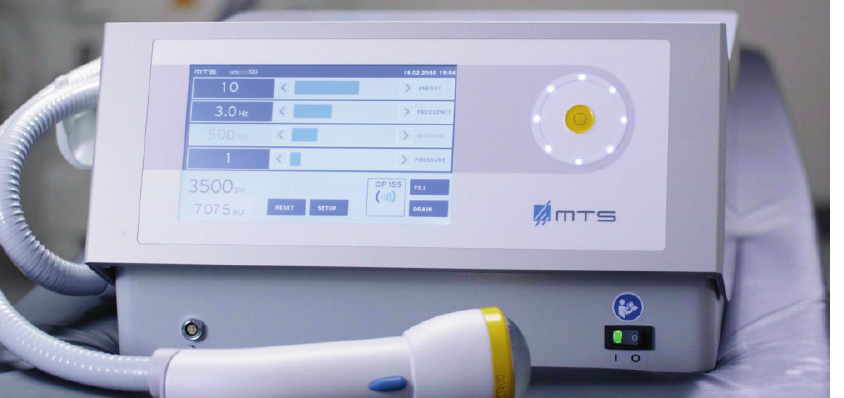
Ask a patient who’s had shockwave therapy somewhere else what the machine actually did, and you’ll usually get some version of “it hurt, but it worked” — or “it hurt, and it didn’t do much.” Both answers usually trace back to the same fact: most devices marketed as “shockwave” on the market today aren’t generating a true shockwave at all. They’re radial pressure wave devices, and while the marketing language overlaps almost completely, the physics doesn’t.
So: what’s actually different, and why does it matter for what you’re paying for?
Two different ways to make a wave
A radial device works pneumatically — compressed air drives a small projectile inside a handpiece, which strikes an applicator tip and sends a pressure wave radiating outward from that point of contact. It’s mechanically simple, which is part of why it’s common, but the wave it produces loses energy quickly as it spreads, so most of the effect stays fairly superficial near the skin. That’s also why radial treatment can cause bruising or noticeable discomfort — the energy is concentrated close to the surface rather than distributed through the tissue.
SoftWave, which is what we use, generates what’s called a true electrohydraulic shockwave. An electrode discharges inside a water-filled applicator head, which creates a rapidly expanding gas bubble (this is the same underlying physics used to break up kidney stones, if that context is familiar) — and that expansion produces a genuine acoustic shockwave that moves through tissue several times faster than sound travels through air. Instead of concentrating at the point of contact like a radial device, SoftWave’s applicator uses a patented parabolic reflector to spread that energy unfocused across a wide and deep treatment zone, reaching structures — a rotator cuff tendon, the plantar fascia, a deep hip bursa — that a radial device’s superficial wave often can’t.
Why some shockwave hurts, and this doesn’t (usually)
Older focused shockwave devices work on a fairly blunt principle: concentrate the wave at a single painful point hard enough to create controlled microtrauma, on the theory that a fresh injury response will out-compete the chronic one. It can work, but it’s uncomfortable enough that clinics using it often numb the area first.
SoftWave’s mechanism is different, and it’s the part patients usually find counterintuitive: instead of injuring tissue to provoke healing, the unfocused wave compresses and expands cell membranes as it passes through — a process called mechanotransduction — which activates the body’s own repair signaling without damaging healthy tissue in the process. You feel pressure and vibration, not the sharp, localized pain that comes with a focused or radial device concentrating energy at one spot. That’s also why we don’t need to numb anything beforehand, and why most patients tolerate a full session comfortably even over a genuinely tender area.
I’ll be honest about where the evidence is strongest and where it’s still developing: extracorporeal shockwave therapy in general has the best-established track record for chronic tendinopathies that haven’t responded to rest or conservative care — plantar fasciitis, tennis and golfer’s elbow, Achilles tendinopathy, calcific rotator cuff tendinopathy. For some of the other conditions we treat with it clinically — knee osteoarthritis, IT band syndrome, ligament sprains that are slow to heal — the research base is thinner, though what exists is generally positive and the biological rationale (stimulating blood flow and collagen turnover in tissue that’s stalled out) is sound. If you’re on the fence about whether shockwave is right for your specific injury, that’s a conversation worth having with us directly rather than assuming the answer from a category label.
What to actually ask if you’re comparing providers
If you’re shockwave-shopping — and given how differently these devices perform, you should be — the questions that actually distinguish the machines are:
- Is this electrohydraulic, or pneumatic/radial? Only the former is a true shockwave by the physics definition.
- Focused or unfocused? Focused devices concentrate energy at a point (more intense, more localized, sometimes requires numbing); unfocused spreads it across a broader, deeper field.
- Does it require a numbing agent? If yes, that’s usually a sign you’re getting a more aggressive, microtrauma-based focused device rather than a mechanotransduction-based one.
None of this means every radial device is useless — for very superficial, localized issues it can still have a role. But if you’ve already tried one type of “shockwave” and didn’t get the result you expected, it’s worth checking which category it actually was before ruling the whole treatment out.
We use the SoftWave OrthoGold 100 at the West Linn clinic, and sessions run $150–$300 depending on the treatment area involved, with package pricing and financing available if you need a course of several sessions. If you’re coming from Lake Oswego or Tualatin, we also have dedicated shockwave pages for those areas with local scheduling details, or you can read more on our main SoftWave therapy page. Bring your questions about your specific injury to your first visit — that’s the actual determinant of whether this is the right tool for you, not the category it falls into.
Dealing with this in West Linn, Lake Oswego or Oregon City?
Same-week appointments. PIP and most insurance accepted.