
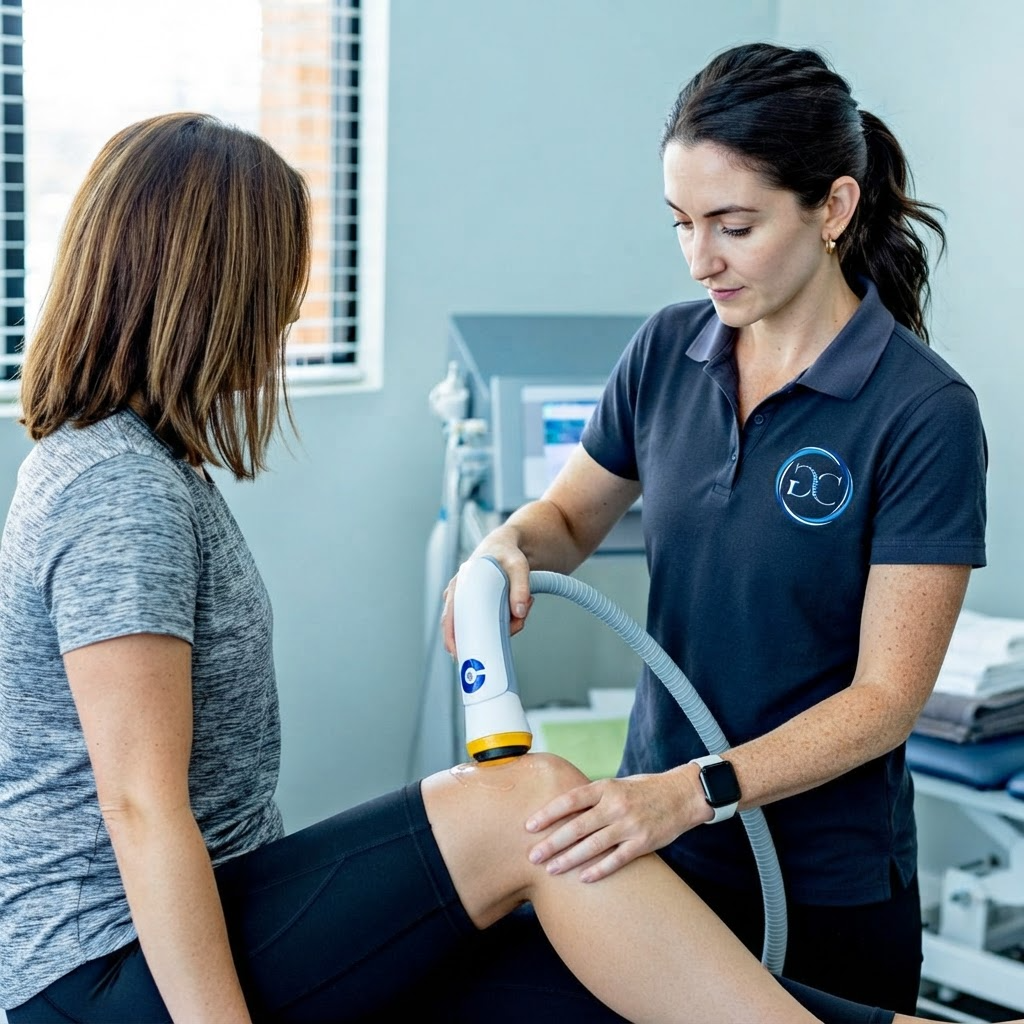
Extracorporeal shockwave therapy has an unusual origin story for a mainstream orthopedic treatment: the underlying technology was originally developed to pulverize kidney stones non-invasively, and clinicians noticed decades ago that patients who happened to also have tendon or bone healing issues saw those improve too. That observation turned into a genuine research program, and the modern result is one of the more consistently well-supported non-drug, non-surgical treatments available for chronic musculoskeletal pain. Here’s what the trial data actually shows, condition by condition, for the injuries we treat with it most often. (If you’re curious how the wave itself is generated, and why not every machine marketed as “shockwave” is delivering the same treatment, I covered that separately in SoftWave vs. Radial Shockwave.)
Plantar fasciitis
This is the single best-studied application of shockwave therapy, and the results are strong. A 2024 meta-analysis and meta-regression pooling 11 randomized trials and 1,081 patients found substantial pain reductions on the standard 0–10 scale — about 2.8 points for focused shockwave and 3.0 points for radial shockwave, both highly statistically significant (Lippi et al., 2024). In direct head-to-head comparisons within those same trials, shockwave outperformed corticosteroid injection on pain reduction at both 4 and 12 weeks, and radial shockwave outperformed ultrasound therapy outright. This held across patients with symptoms ranging from a few months old to nearly three years old — it isn’t a treatment that only works on the freshest cases.
Rotator cuff tendinopathy
This is where the numbers get genuinely impressive. A 2024 systematic review of 16 randomized trials and 1,093 patients found a large reduction in pain compared to control treatment, with significant improvements across every major validated shoulder function score — Constant-Murley, UCLA, and ASES scores all moved in the right direction by a wide margin (Xue et al., 2024). Patients receiving shockwave were more than three times as likely to report a good overall outcome compared to patients who didn’t. For a shoulder problem that often lingers for months and resists rest, ice, and stretching, that’s a meaningful edge.
Tennis elbow (lateral epicondylitis)
Corticosteroid injections have one real advantage over shockwave for tennis elbow: speed. A 2024 meta-analysis of 6 randomized trials (276 patients) found injections produced faster pain relief and better grip strength in the first month (Zhang et al., 2024). But that’s also where the injection’s advantage ends — by 3 months, and again at 6 months, shockwave had overtaken it on both pain and grip strength, and stayed ahead. That pattern makes sense mechanistically: an injection calms inflammation quickly, while shockwave is driving an actual tissue-repair response that takes a few weeks to build but produces a more durable result. If you can tolerate a slightly slower start, the research favors shockwave for getting you actually better rather than just quieter for a while.
Achilles tendinopathy
Achilles tendinopathy is one of the slower-healing injuries we treat, which makes the shockwave data here especially encouraging. A meta-analysis combining 5 randomized trials and 3 case-control studies (442 cases total) found significantly better pain and function scores with shockwave compared to other treatments, and that benefit held at both low and medium energy doses and across both shorter and longer follow-up periods (Fan et al., 2020). The practical takeaway we apply clinically: earlier treatment tends to produce a bigger, faster win, so this is a good injury to bring in early rather than wait out.
Knee osteoarthritis
A 2020 systematic review and meta-analysis of 14 randomized clinical trials found shockwave meaningfully improved both pain and function in knee osteoarthritis patients (Avendaño-Coy et al., 2020). One detail from that review is genuinely useful if you’re comparing providers: medium-energy treatment protocols outperformed both low- and high-energy dosing, which is a reminder that getting the settings right matters as much as having the machine in the first place — it’s part of why we calibrate energy level in real time during treatment rather than running one fixed protocol on everyone.
Why we lean on this treatment
Across five very different conditions — a heel, a shoulder, an elbow, an Achilles tendon, and a knee joint — the pattern in the research is the same: multiple independent research teams, using different patient populations and different trial designs, keep arriving at the same conclusion. That kind of convergence is rare in musculoskeletal medicine, and it’s a big part of why shockwave has become one of the treatments we reach for most often for chronic tendon and joint pain that hasn’t responded to rest, stretching, or physical therapy alone.
If one of these conditions sounds like yours, bring it up at your next visit — I’m glad to walk through exactly where your case fits the research and what a realistic timeline looks like for you.
References
Lippi, L., Folli, A., Moalli, S., Turco, A., Ammendolia, A., de Sire, A., & Invernizzi, M. (2024). Efficacy and tolerability of extracorporeal shock wave therapy in patients with plantar fasciopathy: a systematic review with meta-analysis and meta-regression. European Journal of Physical and Rehabilitation Medicine, 60(5), 832–846. https://doi.org/10.23736/S1973-9087.24.08136-X
Xue, X., Song, Q., Yang, X., Kuati, A., Fu, H., Liu, Y., & Cui, G. (2024). Effect of extracorporeal shockwave therapy for rotator cuff tendinopathy: a systematic review and meta-analysis. BMC Musculoskeletal Disorders, 25, 357. https://doi.org/10.1186/s12891-024-07445-7
Zhang, L., Zhang, X., Pang, L., Wang, Z., & Jiang, J. (2024). Extracorporeal shock wave therapy versus local corticosteroid injection for chronic lateral epicondylitis: a systematic review with meta-analysis of randomized controlled trials. Orthopaedic Surgery, 16(11), 2598–2607. https://doi.org/10.1111/os.14212
Fan, Y., Feng, Z., Cao, J., & Fu, W. (2020). Efficacy of extracorporeal shock wave therapy for Achilles tendinopathy: a meta-analysis. Orthopaedic Journal of Sports Medicine, 8(2), 2325967120903430. https://doi.org/10.1177/2325967120903430
Avendaño-Coy, J., Comino-Suárez, N., Grande-Muñoz, J., Avendaño-López, C., & Gómez-Soriano, J. (2020). Extracorporeal shockwave therapy improves pain and function in subjects with knee osteoarthritis: a systematic review and meta-analysis of randomized clinical trials. International Journal of Surgery, 82, 64–75. https://doi.org/10.1016/j.ijsu.2020.07.055
Dealing with this in West Linn, Lake Oswego or Oregon City?
Same-week appointments. PIP and most insurance accepted.