
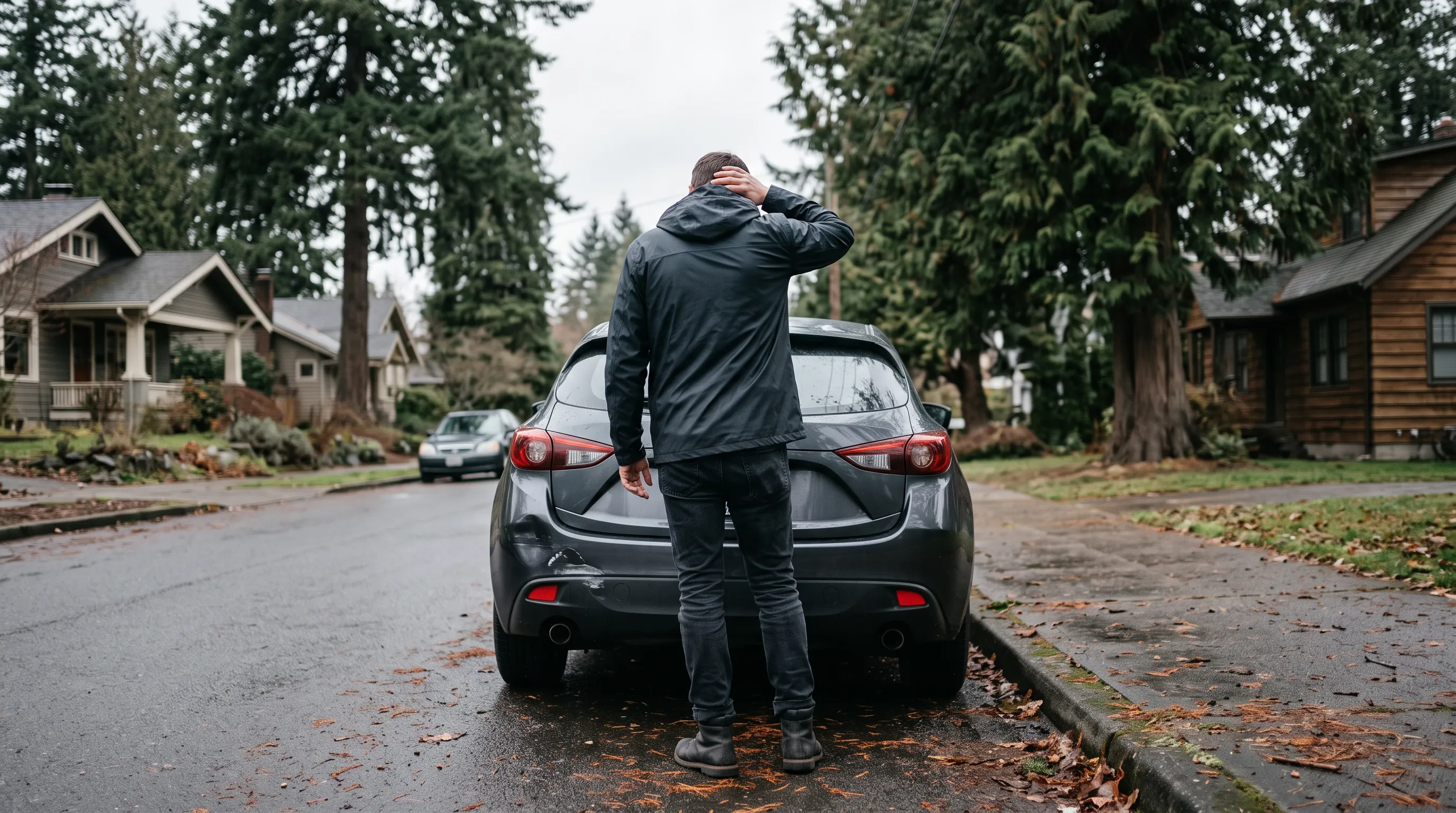
“I feel fine after a car accident, so I probably don’t need to be seen.” I hear some version of this every week. A patient calls, apologizes for even bothering us, and explains that they walked away from their crash feeling okay, so they figured they would just see how things went. Then, three days later, they can barely turn their head.
This is one of the most dangerous misunderstandings in post-accident care. Pain is a poor and often misleading indicator of injury severity after a motor vehicle accident. The soft tissue injuries most common in MVA collisions, whiplash-associated disorders, ligament sprains, disc injuries, and muscle strains, often follow a delayed symptom pattern that has nothing to do with how bad the injury actually is. If you are waiting to feel worse before you seek care, you may be waiting too long.
Why Car Accident Pain Is So Often Delayed
The human body responds to sudden trauma with a cascade of stress hormones, primarily adrenaline and cortisol. These hormones are designed to help you survive an immediate threat. They suppress pain signaling, increase alertness, and mobilize energy reserves. In the minutes and hours following a crash, you may feel shaky, wired, or surprisingly okay, not because nothing is wrong, but because your nervous system is still in emergency mode.
As those hormones normalize over the following 24 to 72 hours, the inflammatory response kicks in. Tissues that were damaged in the collision begin to swell. Joint capsules that were strained become irritated. Muscles that were loaded asymmetrically or beyond their tolerance begin to spasm. This is when the pain shows up.
A 2022 review published in the Journal of Orthopaedic and Sports Physical Therapy found that delayed onset of symptoms after MVA is extremely common, with many patients reporting their most significant pain levels between 48 and 96 hours post-accident. That is two to four days after a crash where they might have initially felt fine.
Soft Tissue Injuries and Why Imaging Often Misses Them
This delayed pain pattern matters enormously for personal injury claims, and it is something I explain carefully to every patient we see at our West Linn clinic.
The injuries most commonly sustained in MVA collisions are soft tissue injuries: sprains and strains of the cervical and lumbar spine, tears or partial tears of paraspinal muscles and ligaments, disc herniations or bulges at any level, and facet joint capsule injuries. With the exception of disc herniations, most of these will not appear on a standard X-ray. Even MRI, which is far more sensitive, can miss subtle ligamentous injuries or early inflammatory changes in the first week after a crash.
This creates a painful irony for patients navigating insurance claims. The ER or urgent care visit taken on the day of the accident may come back with imaging that reads “unremarkable,” which insurance adjusters sometimes interpret as “no injury.” In reality, it often simply means “no fracture” or “no large disc herniation on the day of imaging.” The soft tissue injury severity is not captured.
This is precisely why comprehensive clinical documentation over time matters so much. Chiropractic assessment, functional range of motion testing, orthopedic and neurological exam findings, and outcome measures like the Neck Disability Index build a clinical picture that imaging alone cannot provide.
Injury Severity Does Not Scale With Pain Intensity
Let me be direct about something that surprises many patients: the severity of your injury does not scale with how much pain you feel, especially in the early days.
I have seen patients who described their pain as a two or three out of ten, who, upon examination, had significant cervical instability and restricted range of motion consistent with a grade two whiplash injury. I have also seen patients convinced they had a serious injury based on their pain levels, who recovered quickly once soft tissue inflammation resolved.
A 2024 study in Spine reinforced this point, finding that initial pain scores after whiplash injury were not reliably predictive of injury severity or recovery trajectory. What was predictive: early clinical assessment, baseline range of motion, and whether appropriate care was initiated within the first two weeks.
This is not a reason to dismiss pain. Pain is real, it is meaningful, and I take it seriously. But relying on it as the primary gauge of whether you need care after an accident will lead some people to delay treatment until they have lost weeks of recovery time and have created gaps in their injury documentation that complicate their personal injury claim.
What We Actually Look For in a Post-Accident Exam
When a patient comes into our West Linn clinic after a motor vehicle accident, whether they feel fine or are in significant pain, we run a systematic post-accident evaluation that is designed to find what symptoms alone may not reveal.
That assessment includes:
Cervical and lumbar range of motion: Measured with an inclinometer to establish a baseline. This becomes a critical comparison point as treatment progresses.
Orthopedic testing: Specific tests like Spurling’s, the Distraction Test, and upper and lower limb tension tests help identify nerve root involvement, disc pathology, and facet joint irritation.
Neurological screening: We check sensation, deep tendon reflexes, and upper extremity strength to identify any early signs of nerve compression or cord involvement.
Postural and functional assessment: How you are holding yourself, compensatory movement patterns, and muscle inhibition patterns tell a story that imaging cannot.
Symptom history with timeline: We document every symptom, when it started, and how it has changed, because for a personal injury claim, timeline documentation is as important as the clinical findings themselves.
If anything in that assessment suggests a need for imaging, orthopedic referral, or neurological evaluation, we coordinate that referral. Chiropractic care handles a great deal of soft tissue injury well, but I am clear with patients about what requires a different specialist, and we facilitate that efficiently.
Oregon PIP Insurance and Why Acting Quickly Protects Your Claim
Oregon drivers carry Personal Injury Protection insurance as a mandatory part of their auto coverage. PIP pays for medical treatment regardless of fault, up to your policy limits (a minimum of $15,000 under Oregon law, with many policies carrying more). That coverage includes chiropractic care.
One thing I want patients to understand: waiting to seek care does not just affect your recovery. It can affect your insurance claim. PIP carriers and at-fault liability insurers both look at the timeline between the accident and when treatment began. A gap of more than a week or two between the accident and your first clinical visit can be used to argue that your injuries were not caused by the crash, or that they were not serious enough to warrant immediate care.
I am not in a position to give legal advice, and I always recommend that patients with significant injuries or complex claims consult a personal injury attorney. What I can tell you is that early documentation is in your clinical and legal best interest simultaneously.
When to Come In After a Car Accident in West Linn
My general recommendation for anyone involved in a motor vehicle accident, regardless of initial symptoms, is to be evaluated within 72 hours if possible, and no later than one week post-accident. This timing captures the injury pattern before it becomes entrenched, establishes a baseline that protects your claim, and allows us to begin appropriate treatment before the inflammatory phase has set in and complicated recovery.
If you have already waited longer than that, please do not let it stop you from coming in. We can still provide meaningful care and documentation. But earlier is always better.
Frequently Asked Questions
I felt completely fine after my car accident. Do I still need to see a chiropractor?
Yes, I strongly recommend it. The absence of immediate pain after a crash is common and does not indicate the absence of injury. Soft tissue injuries to the cervical and lumbar spine routinely have a delayed symptom onset of 48 to 96 hours. A clinical evaluation within the first week establishes a baseline, identifies injuries before they become symptomatic, and protects your ability to file an insurance or personal injury claim if symptoms emerge later.
Why do car accident injuries sometimes show up days later?
Your body releases adrenaline and cortisol during and after a crash. These stress hormones suppress pain signaling temporarily. As hormone levels normalize over the following one to three days, the inflammatory response begins, and that is typically when pain and stiffness become apparent. The underlying injury was present from the moment of impact.
How serious is a soft tissue injury from a car accident?
Soft tissue injuries range widely in severity. Grade one injuries involve mild stretching without structural damage and typically resolve within a few weeks with appropriate care. Grade two injuries involve partial tearing of ligament or muscle fibers and may take months to fully resolve. Grade three injuries involve complete rupture and may require surgical evaluation. Pain levels alone are not a reliable indicator of which category your injury falls into. Clinical assessment is required.
Will my Oregon PIP insurance cover chiropractic care after a car accident?
In most cases, yes. Oregon’s Personal Injury Protection coverage, which is mandatory for all Oregon drivers, pays for medically necessary treatment after an accident, including chiropractic care. PIP applies regardless of who caused the accident. Policy minimums are $15,000, though many drivers carry higher limits. We work directly with PIP claims and can help you navigate the billing and documentation process. For questions about your specific policy, your insurance carrier is your best resource.
What should I document after a car accident even before I see a doctor?
Take photos of vehicle damage and the accident scene. Write down a timeline of your symptoms as they appear, noting when each symptom started, how it changed, and how it affects your daily function. Keep records of any medical care you receive, including emergency room visits or urgent care. Avoid making any statements to the other driver’s insurance carrier about your injuries before you have been fully evaluated. And consult a personal injury attorney early if there is any chance you will be filing a liability claim.
If you were recently in an accident and are not sure what your next step should be, we are easy to reach. That is what we are here for.
Dr. Tristan Santiago Maceiras is a Doctor of Chiropractic at Gentle Care Chiropractic in West Linn, Oregon, specializing in musculoskeletal medicine, MVA recovery, and personal injury care.
Dealing with this in West Linn, Lake Oswego or Oregon City?
Same-week appointments. PIP and most insurance accepted.