

Ankle Sprain
Expert care for Ankle Sprain at Gentle Care Chiropractic in West Linn, Oregon.
Understanding Ankle Sprain
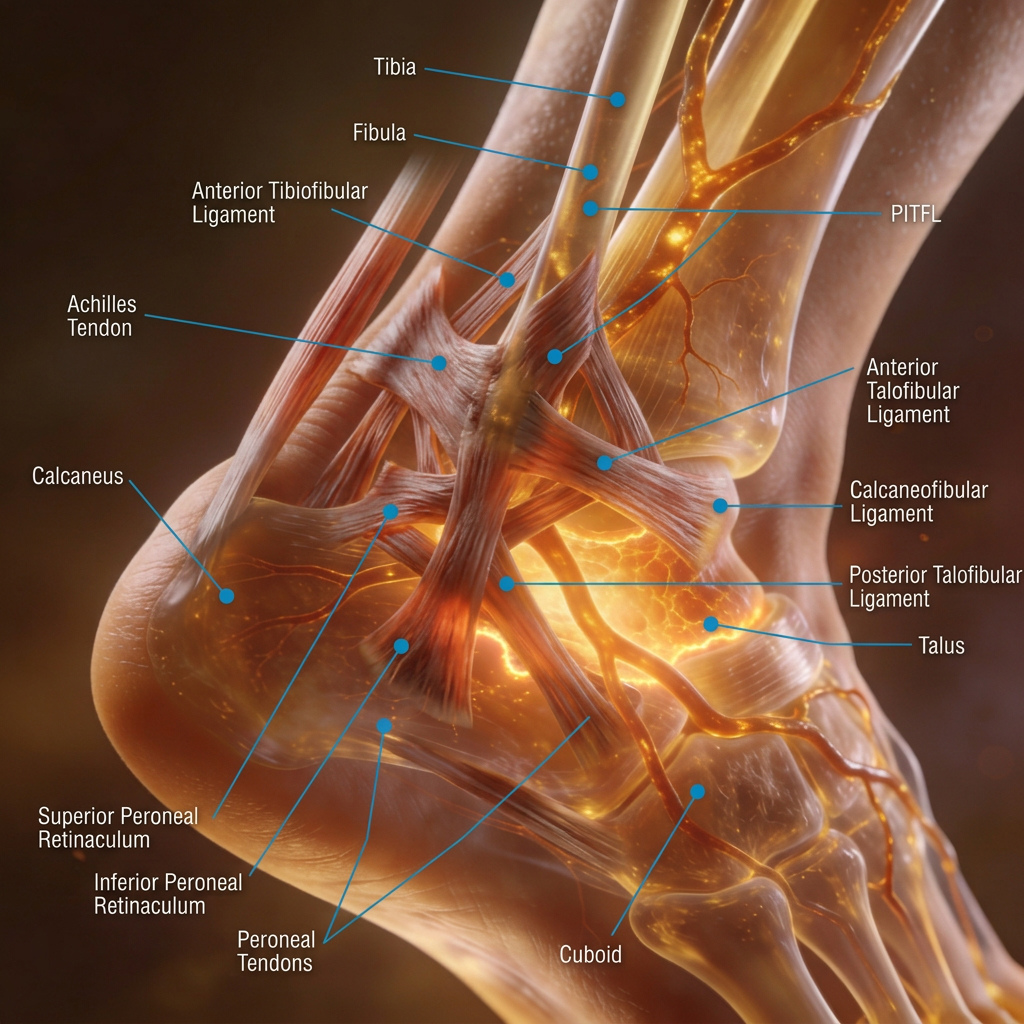
Also known as: Inversion Ankle Sprain, Lateral Ligament Sprain, Rolled Ankle A well-managed lateral ankle sprain heals reliably and fully. A poorly managed one becomes the biggest risk factor for the next sprain, and the one after that. The outside of your ankle is stabilized by three ligaments: the anterior talofibular (ATFL), calcaneofibular (CFL), and posterior talofibular (PTFL). An inversion (rolling inward) injury stretches or tears these, most commonly the ATFL.
The injury is common; the chronic instability that follows undertreated sprains is preventable. You'll remember the moment, a roll on uneven ground, landing on another player's foot, a misstep on stairs. Pain and swelling develop quickly on the outside of the ankle. Walking is painful and the ankle may feel wobbly.
Prior ankle sprain is the single biggest predictor of future sprains, which is why we push for complete rehabilitation, not just pain resolution. We apply Ottawa Ankle Rules at the first visit to determine whether imaging is needed. Assuming no fracture, we restore posterior talar glide (a joint motion commonly lost after ankle sprains that delays recovery if missed) with talocrural and subtalar mobilization. Class IV laser and functional taping allow early motion while protecting the ligament.
Peroneal strengthening, calf and intrinsic foot work, and balance training on a wobble board are what dramatically reduce re-injury risk. Most grade I to II sprains return to sport in two to six weeks. We may recommend: mobilization, extremity adjustments, Class IV laser, kinesio taping, corrective exercise, orthotics, PEMF Seek immediate care if: You cannot bear weight more than a few steps, have tenderness directly over the ankle bones or base of the fifth metatarsal, or the foot appears deformed.
How We Can Help
At Gentle Care Chiropractic, we take a multi-disciplinary approach, addressing the root cause of your condition, not just the symptoms.
Chiropractic Adjustments
Precise spinal and joint corrections to restore alignment, relieve nerve pressure, and reduce pain. Manual or instrument-assisted based on your needs.
Massage Therapy
Therapeutic massage releases muscle tension, improves circulation to injured tissue, and works synergistically with adjustments for faster recovery.
Physical Rehabilitation
Customized exercise programs strengthen supporting muscles, restore range of motion, and help prevent future flare-ups.
Laser Therapy
Cold laser therapy uses targeted light wavelengths to stimulate cellular healing, reduce inflammation, and relieve deep tissue pain without heat or discomfort.
Electrical Stimulation
E-stim therapy reduces pain and muscle spasm, improves circulation, and supports the healing process. Especially effective for acute injuries.
Personalized Care Plan
Every patient is different. We combine these therapies in a plan tailored to your diagnosis, goals, and lifestyle for the best possible outcome.
Dealing with this in West Linn, Lake Oswego or Oregon City?
Same-week appointments. PIP and most insurance accepted.
Frequently Asked Questions
Common questions about Ankle Sprain, answered by our team.
I rolled my ankle. Do I need an X-ray?
We apply the Ottawa Ankle Rules at the first visit to determine this quickly. An X-ray is indicated if you have bone tenderness directly over the posterior edge of either malleolus (the bony bumps on either side of the ankle), or over the base of the fifth metatarsal (the bump on the outside of your foot), or if you cannot bear weight for 4 steps. If none of those criteria are met, the probability of a fracture is very low and imaging isn't necessary. The Rules have a near-100% sensitivity for detecting clinically significant fractures.
My ankle doesn't hurt much anymore. Do I still need rehab?
Yes — this is the most important point about ankle sprains. Pain resolves well before the ligament, proprioceptive (balance) system, and peroneal muscles have fully recovered. Between 20 and 50% of people who "recover" from ankle sprains go on to develop chronic instability — repeated rolling, a sense of giving way, and long-term vulnerability — because they stopped at pain resolution rather than completing the full rehabilitation sequence. The balance training and strength work done after pain resolves are what dramatically cut re-injury risk.
Why does restoring "joint glide" matter after an ankle sprain?
The talocrural joint (where the ankle bone meets the leg bones) has a specific accessory motion called posterior talar glide that is commonly restricted after an ankle sprain. This restriction limits full dorsiflexion (the ability to bring your foot up) even when pain is gone, and reduced dorsiflexion changes how you land and load the entire lower leg with every step. Restoring this joint motion with specific mobilization technique is one of the most evidence-supported manual therapy interventions for ankle sprain and is often the reason one well-targeted adjustment changes function noticeably.
Should I tape my ankle when I return to sport?
Functional taping or a lace-up ankle brace during sport is well-supported for reducing re-sprain risk in the first 6 to 12 months after a significant ankle sprain. Research shows bracing reduces recurrence rates by roughly 40 to 50% compared to no support. This doesn't mean permanent reliance — once proprioception and peroneal strength are fully restored, many athletes discontinue external support without increased risk. Think of it as insurance while the neuromuscular system catches up to the healed ligament.
Is it possible my chronic "weak ankle" is actually from an old sprain that wasn't fully rehabilitated?
Almost certainly, if you've had more than two significant sprains and still feel your ankle gives way on uneven ground. Chronic ankle instability (CAI) is a well-defined condition resulting from incomplete neuromuscular recovery after sprain — the ligament may have healed, but the mechanoreceptors in the damaged tissue that feed your brain position information are disrupted. Proprioceptive training on unstable surfaces, combined with peroneal strengthening, can substantially restore stability even years after the original injury.
Ready to Find Relief?
You don't have to live with Ankle Sprain. Our team at Gentle Care Chiropractic is here to help you recover and get back to doing what you love.