
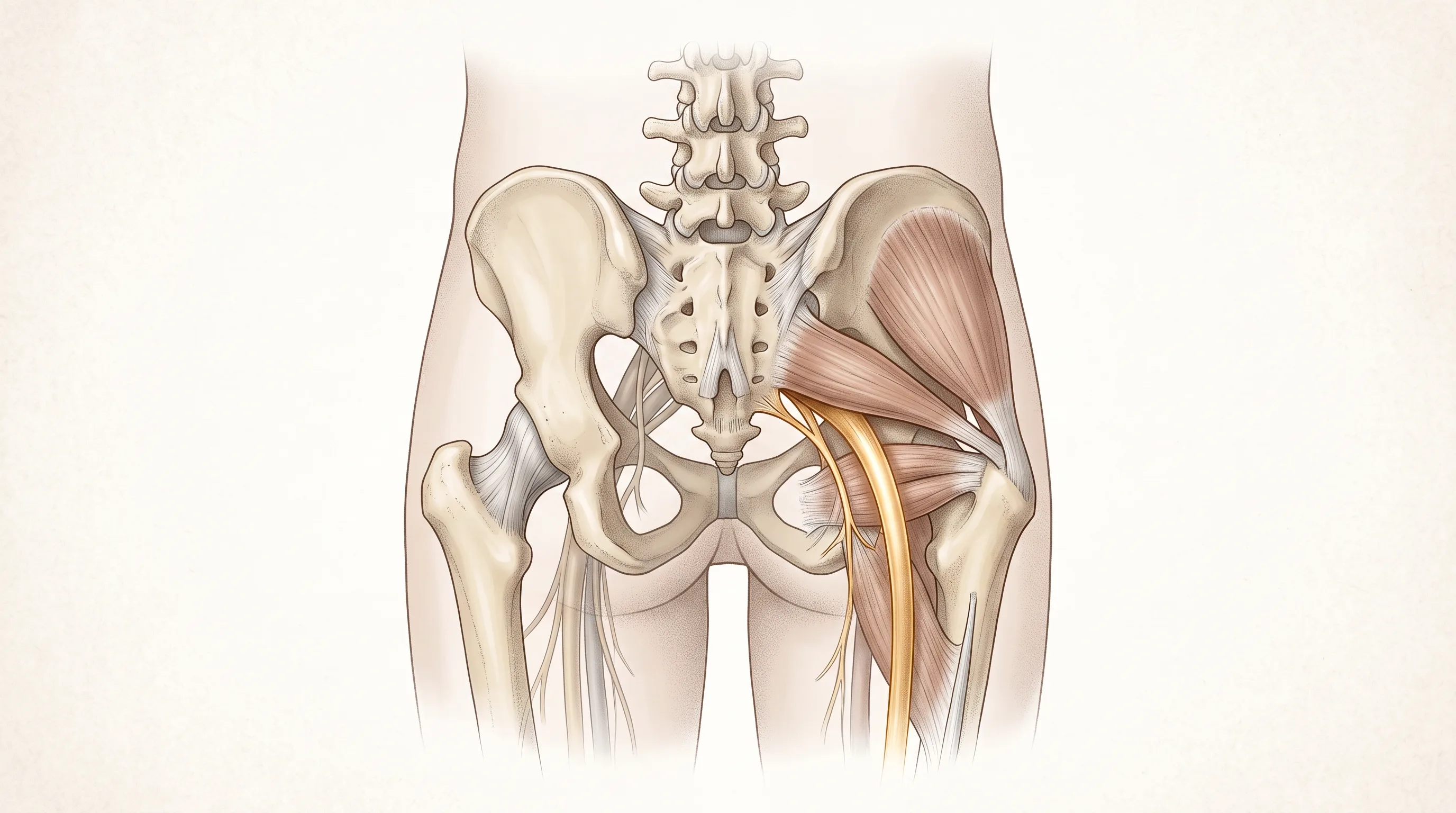
Most patients who walk into our clinic with shooting leg pain have already Googled “sciatica.” Some of them are right. A meaningful number of them are not.
The distinction matters because sciatica treatment that works beautifully for a lumbar disc compression can do absolutely nothing for piriformis syndrome, and vice versa. Treating the wrong structure for weeks prolongs your suffering and frustrates both of us. This post will walk you through how I think about differentiating these two conditions, what the evidence says about each, and what you can realistically expect from chiropractic care.
What Sciatica Actually Is (and Isn’t)
The word “sciatica” gets used loosely, even by clinicians. Technically, sciatica refers to radiculopathy originating in the lumbar spine, where a nerve root is being compressed or chemically irritated before it even exits the spinal canal. The most common culprit is a herniated nucleus pulposus at L4-L5 or L5-S1, where the inner gel of the disc bulges through its outer casing and contacts the nerve root directly.
At the cellular level, disc herniation triggers a cascade mediated by phospholipase A2 and pro-inflammatory cytokines, particularly TNF-alpha and IL-6. These aren’t just mechanical irritants; they lower the activation threshold of nociceptors along the nerve root, which is why true radiculopathy often produces burning, electrical, or lancinating pain that is disproportionate to any physical compression alone.
The clinical hallmarks of true lumbar sciatica include:
- Pain that follows a dermatomal pattern (L5 tracks to the big toe web space; S1 tracks to the lateral foot and heel)
- Neurological deficits: numbness, tingling, or motor weakness in predictable distributions
- Positive straight-leg raise (SLR) test at less than 60 degrees of hip flexion, reproducing the radicular pattern
- Worsening with sitting or lumbar flexion and some relief with walking or extension
A 2023 systematic review in Spine Journal found that the combination of a positive SLR and dermatomal sensory changes has a positive predictive value above 85% for confirmed lumbar nerve root compression on MRI. That is a reliable clinical picture.
Piriformis Syndrome: The Sciatic Nerve Pain That Lives in Your Hip
Piriformis syndrome is a genuinely different animal. Here, the sciatic nerve is compressed or irritated in the deep gluteal space, not in the spinal canal. The piriformis muscle, which runs from the sacrum to the greater trochanter of the femur and functions as an external hip rotator, passes directly adjacent to the sciatic nerve. In roughly 17% of the population, the nerve actually passes through the muscle belly itself, which makes these individuals anatomically predisposed.
When the piriformis develops hypertonia, fibrosis, or becomes a chronic trigger point generator, it can clamp down on the sciatic nerve from the outside. The result is what is sometimes called “deep gluteal syndrome”: buttock-dominant pain, sometimes with radiation down the posterior thigh, that can be nearly indistinguishable from lumbar radiculopathy by symptom description alone.
The key differentiating features I look for in the exam room:
- Pain centered deep in the buttock rather than the low back
- Reproduction of symptoms with the FAIR test (hip flexion, adduction, and internal rotation) or Beatty maneuver, which stretches the piriformis directly
- Negative or equivocal lumbar orthopedic testing (SLR, slump test negative or non-dermatomal)
- Tenderness on direct palpation of the piriformis through the gluteal mass
- No neurological deficits (motor weakness, reflex changes) that map to a specific nerve root level
A 2024 prospective cohort study from the Journal of Orthopaedic and Sports Physical Therapy confirmed that the FAIR test has a sensitivity of 0.88 and specificity of 0.83 for piriformis-mediated sciatic nerve pain when compared against ultrasound-guided diagnostic injection. That is a high-performing clinical test.
Why the Overlap Trips Everyone Up
Both conditions produce pain that radiates from the buttock down the leg. Both are aggravated by sitting. Both can wake you up at night. Here is the wrinkle that makes piriformis syndrome a diagnosis that often gets missed for months: lumbar imaging frequently shows disc changes in people over 40 whether or not those changes are causing the current symptoms. A 2025 JAMA study confirmed that asymptomatic disc herniations are present on MRI in 52% of people over 40 with no history of back pain. That disc on the scan may not be the culprit, even when it looks impressive.
This is where a thorough physical examination outperforms imaging every time for initial triage. I use a sequential approach: lumbar orthopedics first, then hip and piriformis-specific testing, then neurovascular assessment. The pattern of what’s positive and what’s negative draws a much more accurate map than any single test in isolation.
What Treatment Actually Looks Like for Each Condition
For true lumbar sciatica, the evidence base is substantial. Spinal manipulation reduces radicular pain intensity by modulating central sensitization through descending inhibitory pathways, including serotonergic and noradrenergic circuits in the periaqueductal grey. A 2022 Cochrane review confirmed that spinal manipulative therapy produces clinically meaningful short-term reductions in leg pain for lumbar radiculopathy, comparable to NSAIDs with a better safety profile for long-term use.
At our clinic, I combine spinal manipulation at the relevant lumbar segment with neural flossing techniques (sciatic nerve mobilization), posture and load management counseling, and when indicated, Class IV laser therapy to reduce the neuroinflammatory component. Progress is measured in weeks, not days, for true radiculopathy. I tell patients to expect 6 to 8 weeks of active care before reassessing.
For piriformis syndrome, the approach shifts to the soft tissue. Targeted trigger point therapy to the piriformis, combined with hip mobilization and specific stretching of the external rotators, produces faster results than lumbar-focused care. Dry needling is particularly effective for piriformis hypertonia: a 2023 RCT in Pain Medicine demonstrated that ultrasound-guided dry needling to the piriformis produced a 68% reduction in FAIR test pain at four weeks compared to 31% for sham needling. Strengthening the hip abductors and external rotators to address the underlying biomechanical load pattern is the longer-term solution.
What Chiropractic Won’t Do for These Conditions
I want to be direct about limitations because I think patients deserve that.
Chiropractic care is not appropriate as primary management for sciatica with progressive neurological deficit: foot drop, worsening motor weakness, bowel or bladder dysfunction. These are red flags requiring urgent imaging and likely surgical consultation.
For very large disc herniations with significant cauda equina risk, manipulation at the symptomatic level is contraindicated. We can still treat other spinal regions and supporting soft tissue, but the lumbar spine at the level of a large HNP is not a place I will manipulate until imaging confirms it is safe.
Piriformis syndrome that does not respond to 4 to 6 weeks of conservative care deserves a corticosteroid or botulinum toxin injection evaluation. I’m not too proud to refer; these injections are genuinely effective when structural conservative care plateaus.
FAQ: Sciatic Nerve Pain and Piriformis Syndrome
How do I know if my leg pain is sciatica or piriformis syndrome without seeing a doctor?
You likely can’t, and attempting to self-diagnose often delays the right treatment. That said, if your pain starts deep in the buttock rather than your low back and gets significantly worse when you sit cross-legged or do hip-forward stretches, piriformis syndrome is worth investigating.
Can a chiropractor treat piriformis syndrome?
Yes. Myofascial release, trigger point therapy, hip mobilization, and corrective exercise are all within chiropractic scope and have good evidence for piriformis-mediated sciatic nerve pain. Many cases respond well without injections.
How long does piriformis syndrome take to resolve with chiropractic care?
Most patients with piriformis syndrome who have not had the condition for years will see meaningful improvement within 4 to 6 weeks of consistent care. Chronic cases with fibrotic muscle changes can take longer and may need a multimodal approach.
Is it possible to have both sciatica and piriformis syndrome at the same time?
Yes. This is called a double crush syndrome: the nerve is irritated at two points along its path simultaneously. It is more common than most clinicians appreciate and explains why some patients respond incompletely to lumbar-focused care alone. A thorough exam will often catch both contributions.
Should I get an MRI before seeing a chiropractor for leg pain?
Not necessarily, and often not first. Clinical examination is highly accurate for triage, and guidelines from the American College of Physicians recommend against routine imaging for acute low back or leg pain without red flag symptoms. A good exam first protects you from unnecessary procedures and over-attribution of incidental imaging findings.
If you are living with shooting leg pain or deep buttock pain and are not sure whether you are dealing with sciatica or something else, we can help figure that out. A thorough examination takes about 30 minutes and will give you a clearer picture than any amount of Googling. If you have questions or want to find out whether chiropractic care is a good fit for your care plan, we are easy to reach. That is what we are here for.
Dr. Tristan Santiago Maceiras is a Doctor of Chiropractic at Gentle Care Chiropractic in West Linn, Oregon, specializing in musculoskeletal medicine, MVA recovery, and integrated care.
Dealing with this in West Linn, Lake Oswego or Oregon City?
Same-week appointments. PIP and most insurance accepted.