
A patient I see regularly walked into my West Linn, Oregon clinic about two weeks after a rear-end collision. She had been to the emergency room the night of the crash, was told her X-rays were normal, and was sent home with ibuprofen and a recommendation to rest. By the time she reached us, she was waking up at night with arm tingling, struggling to turn her head to check her mirrors while driving, and starting to wonder whether something had been missed.
It had been missed. Not through negligence, but because standard whiplash evaluation in emergency settings is designed to rule out fractures and life-threatening injuries, not to assess the neuromuscular, ligamentous, and proprioceptive disruptions that define whiplash injury recovery for the months that follow.
This post is about what happens to your neck in a rear-end crash that standard imaging does not capture, and why that gap matters for people seeking whiplash treatment in West Linn and throughout the greater Portland area.
What Actually Happens in the First 150 Milliseconds
Most people picture whiplash as a simple “head snapping back.” The actual biomechanics are more complex and explain why the injury so often defies a clean X-ray finding.
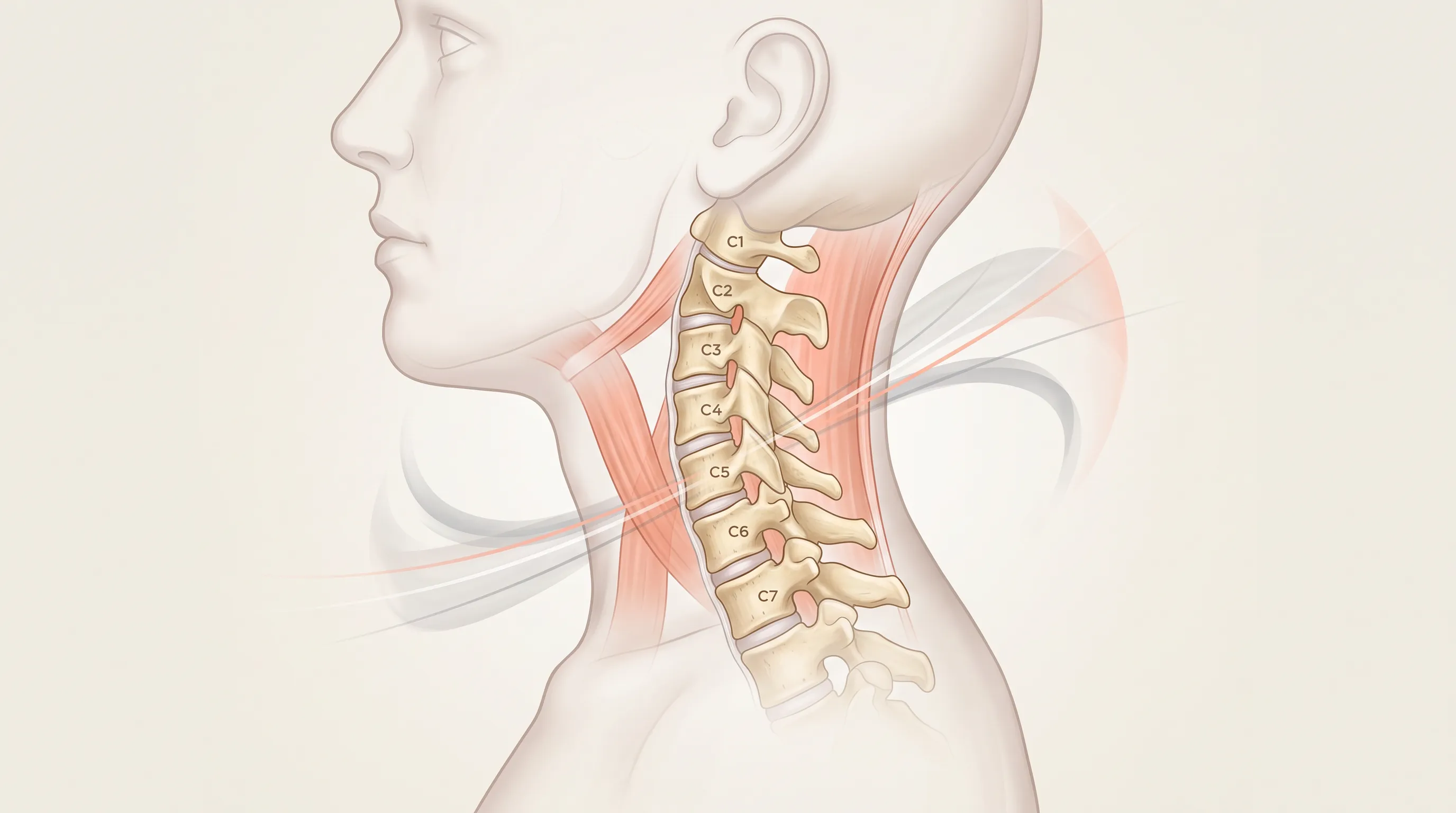
In a typical rear-end collision, your torso accelerates forward with the vehicle before your head does. In that brief window, the lower cervical segments (C5 to C7) undergo a hyperextension force while the upper segments (C1 to C4) are still in relative flexion. The result is what researchers call an S-curve deformation: the spine momentarily takes on an abnormal S-shape that places shearing forces on the intervertebral discs, facet joint capsules, and the deep segmental muscles simultaneously.
A 2023 study published in the Journal of Orthopaedic and Sports Physical Therapy confirmed that this shearing mechanism can produce microtears in facet joint capsule ligaments at acceleration forces as low as 8 to 10 mph, well below the threshold most people associate with significant injury. The absence of vehicle damage does not predict the absence of tissue injury.
What imaging misses in these scenarios: the facet joint capsular ligaments, the alar and transverse ligaments of the upper cervical spine, the deep cervical flexor musculature, and the cervical proprioceptors embedded in the joint capsules and suboccipital muscles.
Why Proprioceptive Disruption Is the Piece Most Clinicians Skip
One of the most underappreciated consequences of whiplash is disruption to the proprioceptive system in the cervical spine. Proprioception is your nervous system’s ability to sense where your body is in space, and the cervical spine is one of the densest regions of proprioceptive nerve endings in the entire body.
When the facet joint capsules and deep cervical muscles are traumatically stretched, the mechanoreceptors embedded in those tissues send inaccurate or inconsistent signals to the brainstem. This is the physiological explanation for symptoms that many whiplash patients describe but that often get dismissed: dizziness, difficulty concentrating, a sense of imbalance, visual disturbance, and fatigue disproportionate to the visible injury.
A 2022 review in Spine found that patients with persistent cervicogenic dizziness after whiplash had measurable deficits in joint position error testing compared to controls, suggesting that the dizziness was not psychological but reflected genuine sensorimotor dysfunction.
Chiropractic care addresses this through joint mobilization and manipulation, which have been shown to restore mechanoreceptor firing patterns and improve proprioceptive accuracy. This is not a secondary or complementary benefit. For many patients, it is the central mechanism of recovery.
The Deep Cervical Flexors: Injured Early, Rehabilitated Late
Another structure routinely underestimated in whiplash is the deep cervical flexor group, particularly the longus colli and longus capitis muscles. These muscles run along the front of the cervical vertebrae and are responsible for stabilizing each cervical segment during movement.
Research using real-time ultrasound imaging has consistently shown that the deep cervical flexors atrophy and lose activation timing within days to weeks of a whiplash injury. When this happens, the more superficial muscles, primarily the sternocleidomastoid and scalenes, attempt to compensate. This compensation pattern increases compressive load on the cervical facet joints and contributes to the persistent aching, stiffness, and headache that many whiplash patients experience long after the initial pain has partially resolved.
Targeted deep cervical flexor rehabilitation is a core component of how we approach whiplash injury recovery at our clinic. Generic neck stretching does not address this. The exercises need to be specific, progressive, and supervised until the patient can demonstrate correct activation patterns independently.
Why Timing of Treatment Matters
One of the most consistent findings in the whiplash literature is that early, appropriate care improves outcomes. A large prospective cohort study published in Pain in 2021 found that patients who initiated active, multimodal treatment within two to three weeks of a whiplash injury had significantly lower rates of chronic pain development at 12 months compared to those who waited or received passive-only care such as rest and medication.
Waiting to see whether the pain resolves on its own is a reasonable instinct. The clinical reality is that inflammatory changes in the cervical facet capsules, combined with altered muscle recruitment patterns and proprioceptive disruption, can become self-reinforcing within four to six weeks of injury if the underlying joint dysfunction is not addressed.
This is a message I find myself delivering often to patients coming to us from across West Linn and the surrounding communities: the window for the most effective intervention is early, and you do not need to be in severe pain to benefit from an evaluation.
What We Assess That a Standard ER Visit Does Not
When a patient presents to our clinic after a motor vehicle accident with suspected whiplash, our evaluation includes:
Cervical segmental motion assessment: identifying restricted or hypermobile segments that do not appear on static imaging.
Deep cervical flexor activation testing: assessing whether the stabilizer muscles are functioning correctly or have shifted into the inhibited pattern common after trauma.
Cervicogenic dizziness screening: a brief but specific set of tests to distinguish dizziness of cervical origin from vestibular or central causes, including the smooth pursuit neck torsion test.
Upper limb tension testing: assessing for radicular involvement from disc or foraminal compression that may not yet be symptomatic enough for a clear neurological finding but that is mechanically present.
Postural and gait observation: how patients carry their head, whether they guard rotation, and how they load their spine walking in are often more informative than a pain scale.
This information shapes a treatment plan that is specific to the injury pattern, not generic to the diagnosis of “whiplash.”
If you are dealing with an active personal injury claim, the documentation generated during this evaluation also becomes part of your medical record. It supports the connection between the collision mechanism and your clinical findings. Patients frequently ask me whether they should wait until they have an attorney before beginning treatment. My recommendation is to begin care as soon as possible. Treatment and documentation proceed together from day one. For questions about how your PIP (personal injury protection) coverage applies to chiropractic care, Oregon’s no-fault system generally allows you to begin chiropractic treatment without waiting for a claim determination. I always encourage patients to consult a personal injury attorney for guidance on the legal side of their claim.
Related Reading
If you were recently in an accident and are not sure what your next step should be, we are easy to reach. That is what we are here for.
Dr. Tristan Santiago Maceiras is a Doctor of Chiropractic at Gentle Care Chiropractic in West Linn, Oregon, specializing in musculoskeletal medicine, MVA recovery, and personal injury care.
Frequently Asked Questions
How long does whiplash treatment in West Linn typically take?
Recovery timelines vary based on injury severity, prior cervical history, and how quickly care begins. Mild to moderate whiplash typically resolves with four to eight weeks of active chiropractic care and rehabilitative exercise. More complex presentations involving disc injury, significant proprioceptive disruption, or delayed presentation may require three to six months of ongoing management. We provide patients with realistic milestone targets from the first visit rather than open-ended treatment.
Can a chiropractor help if my ER X-rays were normal after a car accident?
Yes. Standard X-rays rule out fracture and gross instability but do not evaluate the soft tissue structures, joint capsules, or neuromuscular function that are most commonly injured in whiplash. A chiropractic evaluation includes motion palpation, neurological screening, and functional testing that together provide a much more complete picture of your injury than imaging alone.
Will chiropractic care for whiplash be covered by my Oregon PIP insurance?
In most cases, yes. Oregon’s personal injury protection (PIP) law requires auto insurance policies to include a minimum of $15,000 in medical coverage, and chiropractic care is a covered medical service under Oregon PIP. We work with PIP claims routinely and can help you understand the billing and documentation process. For questions specific to your policy or claim, consulting a personal injury attorney is advisable.
What is cervicogenic dizziness and can it happen after a car accident?
Cervicogenic dizziness is dizziness that originates from disrupted proprioceptive signaling in the cervical spine rather than from the inner ear or brain. It is a recognized consequence of whiplash injury and typically presents as a sensation of imbalance or mild spatial disorientation that worsens with neck movement. It can be distinguished from vestibular dizziness through specific clinical tests. Chiropractic care targeting the cervical segments involved has strong evidence for improving cervicogenic dizziness.
How do I know if my whiplash pain is developing into a chronic condition?
Key warning signs that an acute whiplash injury may be transitioning toward chronicity include: pain that is not improving after six weeks of appropriate care, spreading or radiating symptoms into the arms or hands, increasing sensitivity to light or sound, significant sleep disruption, and cognitive difficulty that persists beyond the first two weeks. If you are experiencing any of these, an updated evaluation is warranted. Early intervention for chronic whiplash trajectories is more effective than waiting until symptoms are firmly established.
Dealing with this in West Linn, Lake Oswego or Oregon City?
Same-week appointments. PIP and most insurance accepted.